

istomastor (@istomastor)
Δημοσιεύσεις
-
The Parable of the Water-Tank
διάφοραThere was a certain very dry land, the people whereof were in sore need of water. And they did nothing but seek after water from morning until night, and many perished because they could not find it.
Howbeit, there were certain men in that land who were more crafty and diligent than the rest, and these had gathered stores of water where others could find none, and these men were called capitalists. And it came to pass that the people of the land came unto the capitalists and prayed them that they would give them of the water they had gathered that they might drink, for their need was sore. But the capitalists answered them and said:
"Go to, ye silly people! Why should we give you of the water we have gathered, for then should we become as ye are, and perish with you. But behold what we will do unto you. Be ye our servants, and ye shall have water."
And the people said, "Only give us to drink, and we will be your servants, we and our children." And it was so.
Wages and Prices
Now, the capitalists were men of understanding, and wise in their generation. They ordered the people who were their servants in bands, with captains and officers, and some they put at the springs to dip, and others did they make to carry the water, and others did they cause to seek for new springs. And all the water was brought together in one place, and there did the capitalists make a great tank for to hold it, and the tank was called the Market, for it was there that the people, even the servants of the capitalists, came to get water. And the capitalists said unto the people:
"For every bucket of water that ye bring to us, that we may pour it into the tank, which is the Market, behold we will give you a penny; but for every bucket that we shall draw forth to give unto you that you may drink of it, ye and your wives and your children, ye shall give to us two pennies, and the difference shall be our profit, seeing that if it were not for this profit we would not do this thing for you, but ye should all perish."
And it was good in the people's eyes for they were dull of understanding, and they diligently brought water unto the tank for many days, and for every bucket which they did bring, the capitalists gave them every man a penny; but for every bucket that the capitalists drew forth from the tank to give again unto the people, behold, the people rendered to the capitalists two pennies.
And after many days the water-tank, which was the Market, overflowed at the top, seeing that for every bucket the people poured in they received only so much as would buy again half-a-bucket. And because of the excess that was left to every bucket, did the tank overflow, for the people were many, but the capitalists were few, and could drink no more than others. Therefore did the tank overflow.
And when the capitalists saw that the water overflowed, they said to the people "See ye not the tank, which is the Market, doth overflow? Sit ye down, therefore, and be patient, for ye shall bring us no more water till the tank be empty."
Unemployment
But when the people no more received the pennies of the capitalists for the water they brought, they could buy no more water from the capitalists, having naught wherewith to buy. And when the capitalist saw that they had no more profit because no man bought water of them, they were troubled. And they sent forth men into the highways, the byways, and the hedges, crying, "If any thirst let him come to the tank and buy water of us, for it doth overflow." For they said among themselves, "Behold, the times are dull; we must advertise."
But the people answered, saying, "How can we buy unless ye hire us, for how else shall we have wherewithal to buy? Hire ye us, therefore, as before, and we will gladly buy water, for we thirst, and ye will have no need to advertise." But the capitalists said to the people: "Shall we hire you to bring water when the tank, which is the Market, doth already overflow? Buy ye, therefore, first water, and when the tank is empty through your buying, we will hire you again."
And so it was because the capitalists hired them no more to bring water that the people could not buy the water they had brought already, and because the people could not buy the water they had brought already, the capitalists no more hired them to bring water.
And the saying went abroad, "It is a crisis."
And the thirst of the people was great, for it was not now as it had been in the days of their fathers, when the land was open before them for everyone to seek water for himself, seeing that the capitalists had taken all the springs, and the wells, and the water-wheels, and the vessels, and the buckets, so that no man might come by water save from the tank, which was the Market. And the people murmured against the capitalists and said: "Behold, the tank runneth over, and we die of thirst. Give us therefore of the water, that we perish not."
But the capitalists answered, "Not so. The water is ours. Ye shall not drink thereof unless ye buy it of us with pennies." And they confirmed it with an oath, saying, after their manner, "Business is business."
But the capitalists were disquieted that the people bought no more water, whereby they had no more profits, and they spake to one another saying, "It seemeth that our profits have stopped our profits, and by reason of the profits we have made we can make no more profits. How is it that our profits are become unprofitable to us, and our gains do make us poor? Let us therefore send for the soothsayers, that they may interpret this thing unto us." And they sent for them.
Now the soothsayers were men learned in dark sayings, who joined themselves to the capitalists by reason of the water of the capitalists, that they might have thereof and live, they and their children. And they spake for the capitalists unto the people, and did their embassies for them, seeing that the capitalists were not a folk quick of understanding, neither ready of speech.
And the capitalists demanded of the soothsayers that they should interpret this thing unto them, wherefore it was that the people bought no more water of them, although the tank was full. And certain of the soothsayers answered and said, "It is by reason of overproduction." And some said, "It is glut." But the signification of the two words is the same. And others said, "Nay, but this thing is by reason of of the spots on the sun." And yet others answered, saying, "It is neither by reason of glut, nor yet of spots on the sun, that the evil hath come to pass, but because of lack of confidence."
Tranquility
And while the soothsayers contended among themselves according to their manner, the men of profit did slumber and sleep, and when they awoke they said to the soothsayers, "It is enough. Ye have spoken comfortably unto us. Now go forth and speak comfortably unto the people, so that they be at rest and leave us also in peace."
But the soothsayers, even the men of the dismal science - for so they were named by some - were loath to go forth to the people lest they should be stoned, for the people loved them not. And they said to the capitalists:
"Masters, it is a mystery of our craft that if men be full and thirst not, but be at rest, then shall they find comfort in our speech, even as ye. Yet if they thirst and be empty, find they no comfort therein, but rather mock at us, for it seemeth that unless a man be full, our wisdom appeareth unto him but emptiness."
But the capitalists said, "Go ye forth. Are ye not our men to do our embassies?"
Starvation because of Abundance
And the soothsayers went forth to the people and expounded to them the mystery of over production, and how it was that they needs must perish of thirst because there was overmuch water, and how there could not be enough because there was too much. And likewise spoke they unto the people concerning the sun-spots, and also wherefore it was that these things had come upon them them by reason of lack of confidence. And it was even as the soothsayers had said, for to the people their wisdom seemed emptiness. And the people reviled them saying, "Go up, ye bald-heads! Will ye mock us? Doth plenty breed famine? Doth nothing come out of much?" And they took up stones to stone them.
And when the capitalists saw that the people still murmured, and would not give ear to the soothsayers, and because also they feared lest they should come upon the tank and take of the water by force, they brought forth to them certain holy men (but they were false priests), who spake unto the people that they should be quiet and trouble not the capitalists because they thirsted. And these holy men, who were false priests, testified to the people that this affliction was sent to them of God for the healing of their souls, and if they should bear it in patience and lust not after the water, neither trouble the capitalists, it would come to pass that after they had given up the ghost they would come to a country where there should be no capitalists, but an abundance of water. Howbeit, there were certain true prophets of God also, and would not prophesy for the capitalists, but rather spake constantly against them.
Charity
Now, when the capitalists saw that the people still murmured and would not be still, neither for the words of the soothsayers nor of the false priests, they came forth themselves unto them, and put the ends of their fingers in the water that overflowed in the tank and wet the tips thereof, and they scattered the drops from the tips of their fingers abroad upon the people who thronged the tank, and the name of the drops of water was charity, and they were exceeding bitter.
The Forces
And when the capitalists saw yet again that neither for the words of the soothsayers, nor of the holy men who were false priests, nor yet for the drops that were called charity, would the people be still, but raged the more, and crowded upon the tank as if they would take it by force, then they took council together and sent men privily forth among the people and all who had skill in war, and took them apart and spake craftily with them saying:
"Come, now, why cast ye not your lot in with the capitalists? If ye will be their men and serve them against the people, that they break not in upon the tank, then shall ye have abundance of water, that ye perish not, ye and your children."
And the mighty men and they who were skilled in war hearkened unto this speech, and suffered themselves to be persuaded, for their thirst constrained them, and they went within unto the capitalists, and became their men, and staves and swords were put into their hands, and they became a defense unto the capitalists, and smote the people when they thronged upon the tank.
Luxury and Waste
And after many days the water was low in the tank, for the capitalists did make fountains and fishponds of the water thereof, and did bathe therein, they and their wives and their children, and did waste the water for their pleasure.
And when the capitalists saw that the tank was empty, they said, "The crisis is ended": and they sent forth and hired the people that they should bring water and fill it again. And for the water that the people brought to the tank they received for every bucket a penny, but for the water which the capitalists drew forth from the tank to give again to the people they received two pennies, that they might have their profit. And after a time did the tank again overflow even as before.
The Agitators
And now, when many times the people had filled the tank until it overflowed, and had thirsted till the water therein had been wasted by the capitalists, it came to pass that there arose in the land certain men who were called agitators for that they did stir up the people. And they spake unto the people, saying that they should associate, and then they would have no need to be servants of the capitalists, and should thirst no more for water. And in the eyes of the capitalists were the agitators pestilent fellows, and they would fain have crucified them, but durst not for fear of the people.
Their Message
And the words of the agitators which they spake to the people were on this wise:
"Ye foolish people, how long will ye deceived by a lie, and believe to your hurt that which is not? For behold, all these things which have been said unto you, by the capitalists and the soothsayers are cunningly devised fables. And likewise the holy men, who say that it is the will of God that you should always be poor and miserable and athirst, behold, they do blaspheme God and are liars, whom He will bitterly judge, though He forgive all others. How cometh it that ye may not come by the water in the tank? Is it not because you have no money? And why have ye no money? Is it not because ye receive but one penny for every bucket that ye bring to the tank, which is the Market, but must render two pennies for every bucket ye take out, so that the capitalists may have their profit? See ye not how by this means the tank must overflow, being filled by that ye lack and made to abound out of your emptiness? See ye not also that the harder ye toil and the more diligently ye seek and bring the water, the worse and not the better it shall be for you by reason of the profit, and that forever?"
The Evil Recognized
After this manner spake the agitators for many days unto the people and none heeded them, but it was so that after a time the people hearkened. And they answered and said unto the agitators:
"Ye say truth. It is because of the capitalists and of their profits we may by no means come by the fruits of our labour, so that our labour is in vain, and the more we toil to fill the tank the sooner doth it overflow, and we may receive nothing because there is too much, according to the words of the soothsayers. But behold the capitalists are hard men, and their tender mercies are cruel. Tell us if ye know any way whereby we may deliver ourselves out of our bondage unto them. But if you know of no certain way of deliverance, we beseech you to hold your peace, and let us alone, that we may forget our misery."
And the agitators answered and said "We know a way."
And the people said: "Deceive us not, for this thing hath been from the beginning, and none hath found a way of deliverance till now, though many have sought it carefully with tears. But if ye know a way, speak unto us quickly."
The Remedy
Then the agitators spake unto the people of the way. And they said:
"Behold, what need have ye at all of these capitalists, that you should yield them profits upon your labor? What great things do they wherefore ye render them this tribute? Lo! it is only because they do order you in bands and lead you out and in and set you tasks, and afterwards give you a little of the water yourselves have brought and not they. Now, behold the way out of this bondage! Do ye for yourselves that which is done by the capitalists - namely, the ordering of your labor and the marshaling of your bands, and the dividing of your tasks. So shall ye have no need at all of the capitalists, and no more yield them any profit, but all the fruit of your labor shall ye share as brethren, everyone having the same; and so shall the tank never overflow until every man is full, and would not wag the tongue for more, and afterwards shall ye with the overflow make pleasant fountains and fishponds to delight yourselves withal, even as did the capitalists: but these shall be for the delight of all."
How to Apply It
And the people answered: "How shall we go about to do this thing, for it seemeth good to us?" And the agitators answered:
"Choose ye discreet men to go in and out before you and marshal your bands and order your labor, and these men shall be as capitalists were; but behold they shall not be your masters as the capitalists are, but your brethren and officers who will do your will, and they shall not take any profits, but every man his share like the others, and there may be no more masters and servants among you, but brethren only. And from time to time, as ye see fit, ye shall choose other discreet men in place of the first to order the labour."
And the people hearkened, and said the thing was very good to them. Likewise it seemed not a hard thing. And with one voice they cried out, "So let it be as ye have said, for we will do it!"
"The End of All Things"
And the capitalists heard the noise of shouting, and what the people said, and the soothsayers heard it also, and likewise the false priests and the mighty men of war, who were a defense unto the capitalists; and when they heard they trembled exceedingly, so that their knees smote together, and they said one to another, "It is the end of us!"
Howbeit, there were certain true priests of the living God who would not prophesy for the capitalists, but had compassion on the people; and when they heard the shouting of the people and what they said, they rejoiced with exceeding great joy, and gave thanks to God because of the deliverance.
And the people went and did all the things that were told them of the agitators to do. And it came to pass as the agitators had said, even according to all their words. And there was no more any thirst in that land, neither any that was a-hungered, not naked, nor cold, nor in any manner of want; and every man said unto his fellow, "My brother," and every woman said unto her companion, "My sister," for so were they with one another as brethren and sisters which do dwell together in unity. And the blessing of God rested upon that land for ever.
The End
-
Ayatollah Sayyid Mujtaba Husayni Khamenei (H) in his statement on the occasion of the 40th day of the martyrdom of Imam Sayyid Ali Husayni Khamenei
διάφορα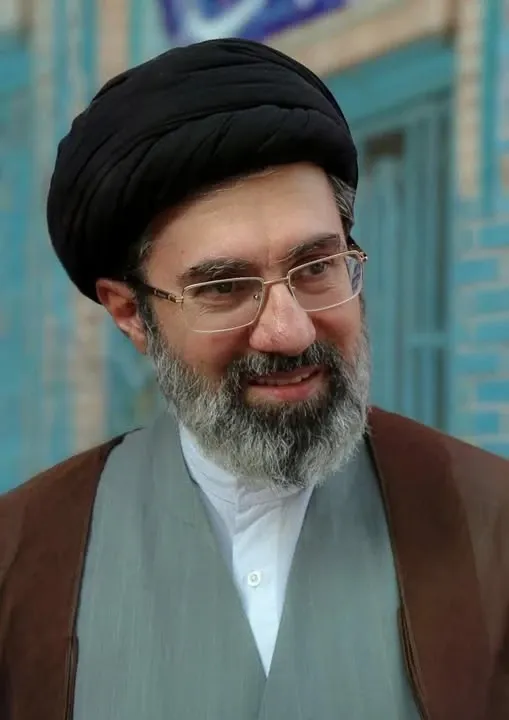
Ayatollah Sayyid Mujtaba Husayni Khamenei (H) in his statement on the occasion of the 40th day of the martyrdom of Imam Sayyid Ali Husayni Khamenei (r) and on issues related to the third imposed war on the Islamic Republic of Iran: (1/7)
In the name of Allah, the Most Gracious, the Most Merciful
Indeed, We have granted you a clear victory so that Allah may forgive for you what preceded of your sin and what will follow, and complete His favor upon you, and guide you to a straight path, and grant you a mighty help.
Forty days have passed since one of the greatest crimes of the enemies of Islam and Iran, and one of the heaviest public griefs in the history of this nation; the grief of the heart-wrenching martyrdom of the sublime leader of the Islamic Revolution, the father of the Iranian nation, the leader of the Islamic Ummah, and the guide of truth-seekers in the present era, the master of martyrs of Iran and the Resistance Front, the great Khamenei, may Allah sanctify his pure soul.
For forty days, the elevated soul of our martyred leader has been a guest in the divine proximity of Allah, attending the banquet of the saints, the truthful, and the martyrs, while simultaneously or thereafter, a large number of companions, commanders, Islamic fighters, and oppressed compatriots—from newborns to the elderly—have attained this immense blessing.
For forty nights and days, Allah the Exalted has called the leader of this Ummah to His covenant; yet this time, unlike what happened in the era of the Speaker of Allah, the companions of the martyred leader and his Ummah were sent to uphold justice and confront falsehood. They stood like steadfast mountains against the Samiri and his calf, and descended like molten fire upon the transgressors and Pharaohs.
For forty continuous days, the arrogant powers of the world have removed their deceptive and false masks, revealing the ugly and satanic face of killing and oppression, aggression and lies, tyranny and infanticide, despotism and corruption.
Yet in response, for forty nights and days, the proud children of the great Khomeini and the dear Khamenei, martyred and followers of pure Muhammadan Islam (peace be upon him and his family), have been present with remarkable dedication and courage in the fields, streets, and battlegrounds, and despite the blows and damages of the brutal enemy attack, they have turned the third imposed war into a scene of a third sacred defense epic. The conscious and vigilant nation of Iran has shown that although it mourns the great separation from its martyred leader, by following the direct heirs of Husayn’s Ashura, it has turned this grief into an epic and mourning into a rallying cry. All this has astonished the heavily armed enemy and drawn the admiration of the free people of the world. This time, the ignorance and foolishness of the arrogant led to Esfand 1404 becoming the beginning of a new era of the rise of Iran and the Islamic Revolution, and the flag of Islamic Iran being raised not only across the geographical territory of our country but in the hearts of truth-seekers around the world.
(2/7)
Qualities and Arts of the Martyred Leader
This occasion provides a good opportunity to briefly introduce the sublime leader. We speak of a man who, despite his fame, was not fully recognized. Everyone knows that our martyred leader was a time-conscious and insightful jurist, an indefatigable struggler, firm and steadfast as a mountain, a knowledgeable and God-fearing scholar, devoted to remembrance, night prayers, and supplication to the Lord, and seeking intercession from the pure and infallible, and deeply believing in Allah’s promises. Among his other qualities were patriotism and persistent efforts for the greater independence of Iran, along with a strong emphasis on unity of word and national cohesion. He spent his life striving for the establishment, stability, and survival of the Islamic system, while considering the Islamic Republic meaningless without its people. Alongside his strength and firmness, he possessed considerable subtlety in thought and perspective. He paid special attention to the capacities of the country, especially its youth, valued science, technology, and progress, and held the families of martyrs, veterans, and devoted ones in high regard. He had extensive and accumulated experiences in various fields, sometimes spanning several decades, and many other qualities that make a long list.
In recent days, some media repeatedly speak of his art, appreciation of art, and cultivation of the arts. While this aspect alone can give great value to a person’s character and was indeed present in our dear leader at the highest level, compared to his other existential elements and merits, it appears small. Personally, I am aware of multiple arts of his:
One great art of his, less often noticed, was the art of educating and shaping society through forming the thoughts, spirits, and emotions of the vast masses and social groups.
Another art of his was the purposeful institution-building, which he undertook especially in the early years of his leadership with a long-term vision.
Another art of his was strengthening the country’s military structure, the positive effects of which the Iranian nation benefited from during the two recent imposed wars.
(3/7)
Also, the power of creativity and innovation in various dimensions, whether scientific, strategic, or policymaking, was among his other arts, a glimpse of which is reflected in the formulation of the general policies of the system. Likewise, the ability to create meanings through timely use of words and original combinations, each generating and carrying a multitude of meanings and forming the public discourse, was another of his arts. Among these was an art that arose from the refinement of his lofty spirit through hardships, trials, and tribulations, and due to his patience and steadfastness in the path of truth: the art of foreseeing distant events, for indeed the believer sees by the light of Allah. Other arts existed as well, which cannot be fully enumerated in this brief account.
All of these arts and merits had no source other than the special graces of Allah and the special attention of our master and his pure forebears, peace be upon them all. Perhaps what drew these graces and attentions toward him can be summarized in his tireless and sincere struggle for the exaltation of the word of truth. More specifically, apart from the hardships of fighting the treacherous Pahlavi regime, he benefited greatly from another special opportunity in the course of fulfilling his duty, which most people are usually unaware of. It was decreed that the young Sayyid, eager for knowledge and also seeking action, at a time when his honorable father was facing blindness, after years of studying under high-ranking scholars, abandoned all apparent prospects of scientific and future-building advancement in Qom and, trusting in Allah’s grace, devoted himself to his father. The divine favor that followed this sacrifice appeared in such a way that suddenly Sayyid Ali Khamenei, before the age of thirty, rose like a sun from Khorasan and soon became considered one of the intellectual and revolutionary pillars, while simultaneously making remarkable progress in conventional sciences; so much so that in the 1970s, the SAVAK referred to him as the “Khomeini of Khorasan.” It must be emphasized that this inner and outward progression of the great leader continued in subsequent periods.
(4/7)
Now, as a lesson from the behavior of great figures, especially such a personality, it is very appropriate to adopt the attitude of sincere benevolence and mutual support, a quality which, combined with attention to the vast mercy of Allah, creates a significant distinction between those who stand under the banner of truth and those who circle around the banner of falsehood. Certainly, pursuing such an attitude opens the doors of heaven and brings down all kinds of divine and unseen assistance, from the descent of rain of mercy to triumph over the enemy and even scientific and technological advancement.
These days, it is repeatedly heard that various groups of dear people rightly and with longing recall that unique era, and gradually more aspects of the luminous essence of his exalted personality are revealed. Likewise, emulating certain actions of that esteemed figure is gradually becoming widespread; for instance, our dear people learned lessons from his clenched fist at the time of martyrdom, and now that same clenched fist has become, for some, a shared symbol of belief. In this way, it is once again proven that the influence of a martyr surpasses that of the living individual, and his resonant voice in calling for monotheism, truth-seeking, and the fight against oppression and corruption, is louder and his message more impactful than during his lifetime. Furthermore, the heartfelt wish of this great martyr that of the happiness of this nation and other Muslim nations has moved closer to reality.
Victory of the Heroic Nation of Iran in the Third Imposed War
Brothers and sisters, fellow countrymen! Today, and up to this point in the third sacred defense epic, it can be said with certainty that you, the heroic nation of Iran, have been the definite victors of this field.
Today, the emergence of the Islamic Republic as a great power and the exposure of the arrogance of the oppressors to weakness before the eyes of all is evident. This is undoubtedly a divine blessing, granted through the blood of our martyred leader, other martyrs wrapped in blood, oppressed compatriots, and the fallen flowers of the Minaab School of the Pure Tree, and through the supplications and entreaties of all the people to the Lord, the devoted presence of the people in fields, neighborhoods, and mosques, and the selfless and sincere sacrifices of the brave fighters of Islam in the IRGC, the Army, the Law Enforcement, the unknown soldiers, and the border guards. Like any blessing, this favor must be acknowledged and appreciated so that it may endure and grow: “If you are grateful, I will surely increase you.” The practical gratitude for this blessing is relentless effort to achieve a strong Iran.
Importance of the Continuity of People’s Presence
What is currently essential for achieving this strategic goal and the martyr leader’s vision is the continuous presence of our dear people, just as they have done over the past forty days. This presence is a key pillar of the status in which a powerful Iran is now established.
(5/7)
Therefore, it should not be assumed that the presence in the streets is unnecessary simply because of announcements based on negotiations with the enemy. Rather, even if, hypothetically, a period of silence on the military battlefield has necessarily arrived, the duty of every individual who has the ability to be present in fields, neighborhoods, and mosques becomes heavier than before. Certainly, your cries in the fields are effective as a result of negotiations; likewise, the astonishingly large and growing millions-strong campaign of self-sacrifice for Iran is also among the influential factors in this arena. By the will of Allah, through these roles and their continuity, the horizon before the Iranian nation promises a glorious, radiant era full of dignity, pride, and prosperity.
When our martyred leader assumed leadership, the Islamic Republic was like a young sapling that had received multiple wounds from the enemies of Islam and Iran, yet had endured them all. But after nearly thirty-seven years, when he stepped down from the seat of leadership of the Ummah, he left behind a blessed tree whose roots were firm and whose branches cast shade over important parts of the region and the world. The approach of achieving “a stronger Iran” passes through unity among the various segments of society, which he repeatedly emphasized. A significant glimpse of this unity was realized in these forty days: hearts of the people drew closer, the divisions between different social groups began to melt, everyone gathered under the banner of the homeland, and day by day both the number and the quality of this gathering increase. Many who have not yet achieved such presence are, in their hearts, aligned and in agreement with the people present in the fields.
These days, many are experiencing a civilizational perspective by looking toward distant horizons and creating for themselves an image that is not imaginary but based on present and future realities. This is a quality that, until recently, was seen only among a few, with the martyred leader at their head. In this way, any observer can perceive the rapid and miraculous growth of this nation, and it is no coincidence that in these days the renowned sage and high-ranking jurist, when speaking to you about this status, is often choked by emotion, unable to speak.
(6/7)
Points Regarding Southern Neighbors, Compensation for Damages, and Blood Price of the Martyrs
In this same context, I say to Iran’s southern neighbors that you are witnessing a miracle. Therefore, see it correctly, understand it properly, stand in the right place, and be wary of the false promises of the suspicious devils. We are still awaiting an appropriate reaction from you so that we may show you brotherhood and goodwill. This will not happen except through your turning away from the arrogant powers, who never miss an opportunity to humiliate and exploit you. Everyone should know that, by the will of Allah, we will certainly not leave unpunished the malicious aggressors who attacked our country. We will definitely demand compensation for every inflicted damage, the blood price of martyrs, and the reparations for the wounded veterans of this war, and we will certainly take the management of the Strait of Hormuz to a new level. We do not seek war and have never sought it, but under no circumstances will we relinquish our legitimate rights, and in this regard we consider the entire Resistance Front as a unified whole.
Recommendations to All Citizens
At this stage, until we reach what rightfully belongs to us, first, all members of the nation should strive to consider one another so that the pressures arising from the inevitable shortages of any war affect various social groups as little as possible. These shortages, which in some cases are much greater on the opposing side, have, thanks to the efforts of your brothers and sisters in the government and other institutions, been managed to a considerable extent.
Second, it is necessary to protect our ears, which are the windows of the mind and heart, against media supported by the enemy or aligned with it. Certainly, those media are not well-wishers of the country and the Iranian nation, and this has been proven repeatedly. Therefore, we should either avoid encountering and using them entirely or, at the very least, treat everything they present with great suspicion.
Third, although the nation, with the end of the official mourning period for its great martyred leader, removes the garments of grief, it keeps alive in spirit and heart a firm determination to avenge the pure blood of him and all the martyrs of the second and third imposed wars and remains constantly vigilant to ensure that this is fulfilled.
(7/7)
In conclusion, I address our master [referring to Imam Mahdi (A)], may Allah hasten his reappearance, that with faith in Allah the Exalted, seeking intercession from the infallible Imams, peace be upon them, and following the example of our martyred leader, we have stood under your banner and against the front of disbelief and arrogance. Along this path, we have offered precious martyrs from various classes for the honor and independence of the country and for the advancement of Islam and the Islamic Revolution, and we have also suffered other losses. Now, with all our being, we rely on your special prayers for decisive triumph over the enemy, both in the arena of negotiations and on the battlefield, and we hope that very soon, both we and our enemies will witness its miraculous effect, insha’Allah.
Peace, mercy, and blessings of Allah be upon you.
— Ayatollah Sayyid Mujtaba Husayni Khamenei
09/04/2026 -
Για τον διωκόμενο φιλόσοφο και κομμουνιστή της Κένυα, Μπούκερ Ομόλε - Μαρξιστικό Κομμουνιστικό Κόμμα Κένυας
διάφορα·
Η αστική δικαιοσύνη κωλυσιεργεί και βασανίζει τον ατρόμητο και ακατάβλητο διωκόμενο σύντροφό μας, φιλόσοφο και κομμουνιστή ηγέτη της Κένυα, Μπούκερ Ομόλε. Ο εκφασισμός μιας τυπικής «αστικής δημοκρατίας» της Αφρικής, είναι απαραίτητο στοιχείο για την μετατροπή της χώρας σε προκεχωρημένο φυλάκιο και στρατηγικής σημασίας ορμητήριο για τους τυχοδιωκτισμούς των ιμπεριαλιστικών ενόπλων δυνάμεων (διωγμένων ταπεινωτικά από τις χώρες του ΣΑΧΕΛ) και των ΗΠΑ, ιδιαίτερα μετά την ταπεινωτική ήττα του άξονα απ’ το Ιράν και τον Άξονα της αντίστασης. ΕΝΗΜΕΡΩΣΗ ΑΠΟ ΤΟ ΔΙΚΑΣΤΗΡΙΟ: ΔΙΚΑΣΤΗΡΙΑ ΤΟΥ ΜΑΒΟΚΟ – Η ΥΠΟΘΕΣΗ ΤΗΣ ΕΙΣΑΓΓΕΛΕΙΑΣ ΕΝΑΝΤΙΟΝ ΤΟΥ σ. Booker Ngesa Omole Booker Ngesa Omole ΣΥΝΕΧΙΖΕΙ ΝΑ ΚΑΤΑΡΡΕΕΙ https://www.facebook.com/reel/966832162534735 Ο αγώνας συνεχίζεται. Η αλήθεια συνεχίζει να αποκαλύπτεται. Οι αντιφάσεις στο στρατόπεδο του εχθρού συνεχίζουν να οξύνονται. Στα Δικαστήρια του Μαβόκο, υπό την προεδρία της Εντιμότατης Δικαστού Μ. Νανζούσι (S.P.M), σημειώθηκε σημαντική εξέλιξη στην υπόθεση της καταγγελίας του Γενικού Γραμματέα του Μαρξιστικού Κομμουνιστικού Κόμματος της Κένυας, Μπούκερ Ομόλε, εναντίον του κράτους της Κένυας. Η προεδρεύουσα δικαστής αποσύρθηκε επίσημα από την υπόθεση. Η απόφαση αυτή ακολουθεί μια σειρά γεγονότων που αποκαλύπτουν, με όλο και μεγαλύτερη σαφήνεια, τον πολιτικό χαρακτήρα των κατηγοριών που απαγγέλθηκαν εναντίον του συντρόφου Omole. Το δικαστήριο είχε εκδώσει νωρίτερα κλήτευση με την οποία ζητούσε από τον Διοικητή του Σταθμού (OCS) Mlolongo, Peter Mugambi, να εμφανιστεί και να εξηγήσει τις περιστάσεις που περιβάλλουν τις κατασκευασμένες κατηγορίες, καθώς και τη συνεχιζόμενη παράνομη παρακράτηση των προσωπικών αντικειμένων του κατηγορουμένου. Αυτά περιλαμβάνουν αντικείμενα τα οποία το δικαστήριο είχε ήδη διατάξει να επιστραφούν. https://x.com/communistske/status/2041836971455025249... Ωστόσο, αψηφώντας το δικαστήριο, ο OCS δεν εμφανίστηκε. Η παράλειψη αυτή δεν ήταν διαδικαστική. Ήταν πολιτική. Ήταν σκόπιμη. Ήταν πράξη περιφρόνησης, όχι μόνο έναντι του δικαστηρίου, αλλά και έναντι της ίδιας της έννοιας της δικαιοσύνης. Ο συνήγορος του κατηγορουμένου, ο δικηγόρος Kioi, έθεσε ορθώς το ζήτημα και ζήτησε την έκδοση εντάλματος σύλληψης εναντίον του OCS. Ωστόσο, αντί να επιβάλει την εξουσία του έναντι ενός μη ανταποκρινόμενου στα καθήκοντά του κρατικού φορέα, το δικαστήριο δήλωσε ότι βρισκόταν σε σύγκρουση συμφερόντων και η δικαστής απέρριψε την περαιτέρω εκδίκαση της υπόθεσης. Αυτή η αποχή πρέπει να γίνει κατανοητή για αυτό που είναι. Είναι μια αντανάκλαση των βαθιών αντιφάσεων εντός του κρατικού μηχανισμού όταν αντιμετωπίζει μια υπόθεση που δεν είναι νομική κατ' ουσία, αλλά έχει πολιτική υπόσταση. Πρέπει επίσης να σημειωθεί ότι πρόκειται για τον ίδιο δικαστή που είχε προηγουμένως αρνηθεί να δεχθεί ως αποδεικτικό στοιχείο μια ένορκη βεβαίωση ανάκλησης του βασικού μάρτυρα κατηγορίας, του Άντριου Άμοθ. Στην εν λόγω ένορκη βεβαίωση, ο μάρτυρας περιέγραφε λεπτομερώς πώς ο ανακριτής, κ. Μουνένε, σε συνεργασία με τον υπεύθυνο της αστυνομικής υπηρεσίας (OCS) Μουγκάμπι, σκηνοθέτησε και κατασκεύασε τις κατηγορίες, σε μια σαφή απόπειρα πολιτικής δίωξης. Ήδη από προηγούμενες διαδικασίες είχε αρχίσει να καταρρέει η υπόθεση της πολιτείας. Ο καταγγέλλων είχε υποβάλει αίτηση απόσυρσης της καταγγελίας, ενώ βασικά στοιχεία των κατηγοριών, συμπεριλαμβανομένων των ισχυρισμών που αφορούσαν την κατάχρηση πυροβόλων όπλων, αποδείχθηκαν αβάσιμα και ασυμβίβαστα με τα γεγονότα. Αυτό που βιώνουμε δεν είναι μια κανονική δικαστική διαδικασία. Αυτό που βιώνουμε είναι η αποκάλυψη μιας πολιτικής δίωξης. Μια δίωξη που δεν βασίζεται σε αποδεικτικά στοιχεία, αλλά στην καταστολή. Μια δίωξη που δεν βασίζεται στο νόμο, αλλά στον φόβο. Μια δίωξη που δεν βασίζεται στη δικαιοσύνη, αλλά στην απελπισία μιας άρχουσας τάξης που αντιμετωπίζει ένα ανερχόμενο επαναστατικό κίνημα. Αλλά η ιστορία μας διδάσκει το εξής: όταν ο καταπιεστής απελπίζεται, η αλήθεια αρχίζει να διαρρέει από τις ρωγμές. Η μη εμφάνιση του OCS. Η απόσυρση του βασικού μάρτυρα. Οι αντιφάσεις στο κατηγορητήριο. Η αποχή του δικαστή. Αυτά δεν είναι μεμονωμένα περιστατικά. Είναι συμπτώματα μιας υπόθεσης που καταρρέει. Ο λαός πρέπει να παραμείνει σε εγρήγορση. Το κίνημα πρέπει να παραμείνει οργανωμένο. Ο αγώνας πρέπει να ενταθεί. Γιατί αυτή η υπόθεση δεν αφορά ένα άτομο. Αφορά το δικαίωμα της εργατικής τάξης να οργανώνεται. Αφορά το δικαίωμα των επαναστατών να μιλούν. Αφορά το ίδιο το μέλλον της Κένυας. Και η ιστορία είναι ξεκάθαρη. Καμία καταστολή δεν έχει νικήσει ποτέ έναν λαό οργανωμένο στον αγώνα. Κεντρική Οργανωτική Επιτροπή, Μαρξιστικό Κομμουνιστικό Κόμμα Κένυας.
COURT UPDATE: MAVOKO LAW COURTS – THE STATE’S CASE AGAINST BOOKER OMOLE CONTINUES TO CRUMBLE
— Communist Party Marxist CPM - Kenya (@CommunistsKe) April 8, 2026
The struggle continues. The truth continues to emerge. The contradictions within the camp of the enemy continue to sharpen. pic.twitter.com/3xGvwdGFsW -
Stalin as Scientist
διάφοραJ. D. Bernal, F.R.S.
Modern Quarterly Vol. 8. No. 3, Summer 1953.
In thinking of Stalin as the greatest figure of contemporary history we should not overlook the fact that he was at the same time a great scientist, not only in his direct contribution to social science, but, even more, in the impetus and the opportunity he gave to every branch of science and technique and in the creation of the new, expanding and popular science of the Soviet Union.
Stalin's contribution to the development of science cannot be separated from his great work as the builder and preserver of socialism. He combined, as no man had before his time, a deep theoretical understanding with unfailing mastery of practice. And this was no accident. The success of Stalin both in his creative role and in his many battles against apparently overwhelming forces, was due precisely to his grasp of the science of Marxism as a living force. In learning from Marxism and in using Marxism he developed it still further. He will stand now and for all time beside Marx, Engels and Lenin, as one of the great formulators of the transforming of thought and society in the most critical stage of human evolution. In their different ways they each had crucial tasks to fulfil. Marx and Engels had to achieve the first knowledge of the nature of capitalist exploitation and of scientific socialism, at a time when the domination of capitalism seemed assured beyond any question, and had to create the methods of dialectical materialism completely foreign to the official thought of the time. They had to bring to the newly emerging industrial working class the first consciousness of their strength and destiny. Lenin was the first to make the decisive break and, through the creation of a communist party of a new kind, succeeded by revolution in forming the first socialist state. But he lived only to see it triumphant against the first onslaught of its enemies. The task of turning a backward and half-ruined country into a great and prosperous industrial and military power, the task of showing that socialism would work, was, throughout all the crises of internal difficulties and external attack, the responsibility of Stalin and history records his success.
But though his was the guiding hand and his also the undaunted strength of purpose that all could rely on, this achievement was the achievement of hundreds of millions of men and women infused with the same determination and inspired by the same ideas. The true greatness of Stalin as a leader was his wonderful combination of a deeply scientific approach to all problems with his capacity for feeling and expressing himself in simple and direct human terms. His grasp of theory never left him without clear direction. His humanity always prevented him from becoming doctrinaire. He expressed himself on this point most clearly in his answer to Kholopov in the linguistics controversy:
"The dogmatists and talmudists regard Marxism and the various conclusions and formulae of Marxism as a collection of dogmas, which 'never' change, despite changes in the conditions of the development of society. They think that if they learn these conclusions and formulae by heart and begin to quote them without rhyme or reason, they will be able to solve any problems whatever, reckoning that the memorized conclusions and formulae will serve them for every period and country, for every possible contingency. But this idea can be entertained only by people who see the letter of Marxism, but not its essence, who learn by rote the texts of conclusions and formulae of Marxism, but do not understand their content.
"Marxism is the science of the laws governing the development of nature and society, the science of the revolution of the oppressed and exploited masses, the science of the victory of Socialism in all countries, the science of building a Communist society. Marxism as a science cannot stand still, it develops and improves. In its development Marxism cannot but enrich itself with new experience, new knowledge—consequently its various formulae and conclusions cannot but change with the passage of time, cannot but be replaced by new formulae and conclusions, which correspond to the new historical tasks. Marxism does not recognize immutable conclusions and formulae, obligatory for all epochs and periods. Marxism is the enemy of all dogmatism."
The study of Stalin's written works needs to be related step by step with the actual political, social and economic problems which called them forth and which in turn they illuminate. In his youth he counted as a "practical" Marxist though this was largely because his success in revolutionary agitation masked his profound and wide reading. The amount of economic and philosophical material that this student from remote and backward Georgia mastered sixty years ago is enough to put to shame students of to-day in advanced centres of culture. It included such diverse works as Darwin's Descent of Man, Lyell's Antiquity of Man, Adam Smith's and David Ricardo's books on political economy, Victor Hugo's Toilers of the Sea, Thackeray's Vanity Fair, Buckle's History of Civilisation in England, Mendeleev's Chemistry, Spinoza's Ethics, and the classics of Shakespeare, Schiller and Tolstoy. Already in the seminary of Tiflis, as his earliest writings show, he had seized on the essentially scientific character of Marxism. He could see that it was no arbitrary creation but the discovery of objective laws of nature and of society. That concept of scientific law never left him. He gave it its fullest expression in the last of his great contributions to Marxism, the Economic Problems of Socialism in the U.S.S.R. There at the outset he states categorically:
"Marxism regards laws of science—whether they be laws of natural science or laws of political economy—as the reflection of objective processes which take place independently of the will of man. Man may discover these laws, get to know them, study them, reckon with them in his activities and utilize them in the interests of society, but he cannot change or abolish them. Still less can he form or create new laws of science."
Though Stalin had no professional connection with science, apart from a few months as an observer and computer at the observatory of Tiflis, he retained a lively and practical interest in the progress of science and his appreciation of its needs and difficulties was of decisive importance to the great efflorescence and transformation of science in the Soviet Union.
The chapter on "Dialectical Materialism" which Stalin contributed to the History of the Communist Party of the Soviet Union is the finest example of his range of understanding and his skill in exposition, which he had first shown in his Anarchism and Socialism forty-six years before. Set out simply and logically are the ideas on the development of the world and of society that are to be found scattered in many places and often obscurely expressed in the writings of Marx, Engels and Lenin. The simplicity is somewhat deceptive. In a short compass are ideas and formulations that are worth reading many times over and from which many new ideas and practical applications can be extracted. Particularly illuminating are his remarks on the science of the history of society which "despite all the complexity of the phenomena of social life can become as precise a science as, let us say, biology and capable of making use of the laws of the development of society for practical purposes" (Leninism, p. 601). Here also we find the idea which he developed further in Concerning Marxism in Linguistics, of the nature of ideological superstructure and of the importance of social ideas:
"New social ideas and theories arise only after the development of the material life of society has set new tasks before society. But once they have arisen they become a most potent force which facilitates the carrying out of the new tasks set by the development of the material life of society, a force which facilitates the progress of society. It is precisely here that the tremendous organizing, mobilizing and transforming value of new ideas, new theories, new political views and new political institutions manifests itself. New social ideas and theories arise precisely because they are necessary to society, because it is impossible to carry out the urgent tasks of development of the material life of society without their organizing, mobilizing and transforming action. Arising out of the new tasks set by the development of the material life of society, the new social ideas and theories force their way through, become the possession of the masses, mobilize and organize them against the moribund forces of society, and thus facilitate the overthrow of these forces which hamper the development of the material life of society"
(Leninism, p. 603).Throughout, and from the very beginning of his mastery of Marxism, Stalin maintained a dynamic conception of natural and social progress. He noted and confidently relied on the triumph of the growing, and the defeat of the decaying, forces of society whatever their apparent strength at the time. As early as 1906 he wrote,
"That in life which is born and grows day after day is invincible, its progress cannot be checked. That is to say, if, for example, the proletariat as a class is born and grows day after day, no matter how weak and small in numbers it may be today, in the long run, it must conquer. Why? Because it is growing, gaining strength and marching forward. On the other hand, that in life which grows old and is advancing to its grave must inevitably sustain defeat even if today it represents a titanic force. That is to say, if, for example, the ground is gradually slipping from under the feet of the bourgeoisie, and the latter is slipping further and further back every day, no matter how strong and numerous it may be today, it must, in the long run, sustain defeat. Why? Because as a class it is decaying, growing feeble, growing old, and becoming a burden to life"
(Anarchism or Socialism?, J. Stalin, Foreign Languages Publishing House, Moscow, 1950).It was this belief firmly founded on science that helped to surmount successive dangers without ever losing heart.
This exposition of Marxism is however only a nucleus to which Stalin added in practice and theory contributions of his own. The major contribution, characteristic both of the man and of the creation of socialism in one country, can be summed up in one phrase—learning with the people. Stalin's capacity to learn was the secret of his success in action. It began with his first political experience.
"My first teachers were the workers of Tiflis" (Pravda, June 16, 1926) and it lasted to the very end as the Economic Problems of Socialism in the U.S.S.R. shows. It is the basis of his most celebrated parallel of Bolsheviks to the giant Antaeus of the fable who was strong only if he kept his feet on mother earth, "As long as they maintain connection with their mother, with the people, they have every chance of remaining invincible"
(History of the C.P.S.U.(B.) p. 363).It was this profound feeling for the people and for people as individuals that gave Stalin himself his sure touch in good and bad times alike. It was the basis for his judgment that kept a balance between doctrinaires who wished to push forward irrespective of circumstances, and the cautious time-servers who would go no faster than the slowest of the crowd. He showed it at its best in his decisive Pravda article of March 2, 1930, "Dizzy with Success", where he checked, and only just in time, the irresponsible and self-defeating forcing of the pace of collectivisation.
That great double transformation, the industrialisation of the Five Year plans, and the formation of collective farms is Stalin's most enduring monument but, though it needed profound economic and technical study and the greatest firmness of purpose in execution, it was only possible because it expressed the active will of the great majority of the peoples of the Soviet Union.
Shallow thinkers, philosophic defenders of "Western Civilisation," have accused Stalin of being motivated by love of power, but to those who have followed his thoughts and works, the accusation is only a revelation of utter ignorance. Stalin understood the nature of political power far too well to imagine that it was something that could be sought or held by any man or group of men. He knew that the events of political life only express the outcome of social forces, of the wills and aspirations of millions of men who can only be moved if and when the material conditions are propitious and they are conscious of this.
"It would be foolish to think that the production plan is a mere enumeration of figures and assignments. Actually, the production plan is the embodiment of the living and practical activity of millions of people. What makes our production plan real is the millions of working people who are creating a new life. What makes our plan real is the living people, it is you and I, our will to work, our readiness to work in the new way, our determination to carry out the plan"
(Leninism, p. 387).Over and over again by example and warning Stalin urged the need for the way of co-operation and persuasion and denounced the bureaucratic practice of administrative orders. He had nothing but contempt for the bogus "Fuhrer prinzip" which led Hitler to his doom.
As he insisted once again in his last work, the laws of social progress are objective: they cannot be laid down, they must be discovered; and in the process of discovering them, there is always the possibility of revealing the new and unexpected. The transformation of capitalism to socialism and of socialism to communism produced many surprises, good as well as bad. It was Stalin's peculiar genius to detect and cherish the significant new manifestations. It came all the more naturally to him because of his ability to appreciate and cherish the achievements of individuals and to learn the lessons they could teach.
The most striking example of this was his immediate seizing of the achievement of Stakhanov and his understanding that here was not merely someone who worked harder and more enthusiastically, but someone from the ranks of the workers who had mastered modern scientific technique and was able to combine it with his practical experience. Stalin saw at once that this opened the way to using the hitherto untapped reserves of intelligence of the people which capitalism could never touch, and that it broke at once the barriers of accepted standards of production. Here, for the first time in history, the workers were entering science in a positive way and science must make way for them:
"People talk about science. They say that the data of science, the data contained in technical handbooks and instructions, contradict the demands of the Stakhanovites for new and higher technical standards. But what kind of science are they talking about? The data of science have always been tested by practice, by experience. Science which has severed contact with practice, with experience—what sort of science is that? If science were the thing it is represented to be by certain of our conservative comrades, it would have perished for humanity long ago. Science is called science just because it does not recognize fetishes, just because it does not fear to raise its hand against the obsolete and antiquated, and because it lends an attentive ear to the voice of experience, of practice"
(Leninism, p. 555).This was his appreciation of the revolutionary effect of a whole working population contributing to the making of knowledge and not merely to the using of it. Stalin drew the moral in his toast to science at a gathering of workers in higher education in May, 1936:
"To the flourishing of science! Of such science as does not segregate itself from the people, does not keep aloof from the people but which is ready to serve the people, to place all its achievements at the disposal of the people; of the science which serves the people, not under constraint, but voluntarily, willingly. ...
"To the flourishing of science! Of such science whose devotees, while realising the force and significance of the traditions established in science and making skilful use of them in the interests of science, yet refuse to be slave to these traditions; of science which has the daring and determination to shatter old traditions, standards, and methods when they become obsolete, when they turn into a brake on progress, and which is able to establish new traditions, new standards, new methods.
"In the course of its development science has known quite a number of courageous people who have been able to shatter the old and establish the new regardless of, and in the teeth of all obstacles. Such men of science as Galileo, Darwin, and many others are widely known. I should like to dwell on one such Corythaeus [Coryphaeus] of science who is at the same time the greatest man of modern science, I have in mind Lenin, our teacher, our mentor ...
"It also happens that new trails in science and technique are sometimes blazed, not by widely known scientists, but by people who are absolutely unknown in the scientific world, by ordinary people, men engaged in practical work, innovators. Here at the table with us all sit comrades Stakhanov and Papanin, men unknown in the scientific world, without academic degrees, practical workers in their fields of activity. But who does not know that Stakhanov and the Stakhanovites in their practical work in the field of industry scrapped as obsolete the existing standards established by well-known men of science and technique and introduced new standards, corresponding to the demands of real science and technique? Who does not know that Papanin and the Papaninites in their practical work on the drifting ice-flow, incidentally without any special effort, scrapped as obsolete the old conception of the Arctic and established a new one corresponding to the demands of real science? Who can deny that Stakhanov and Papanin are innovators in science, men of our advanced science?"
(International Book Review, Nos. 1-2, published, Marx Memorial Library, 1938).The development took shape even more clearly after the second World War with the recognition of the two complementary groups of worker-scientists, the rationalisers who continually improved production in detail and the innovators who provoke radical alterations in the mode of production.
The discovery of the unlimited new source of scientific and technical advancement that lay hidden, and was indeed actively suppressed by all earlier systems, will in the long run prove the greatest of benefits conferred to socialism. Stalin saw well how it was needed to pave the way to the next stage, the transition to communism. This involved the abolition of the essential distinction between mental and physical labour:
"It is necessary, in the third place, to ensure such a cultural advancement of society as will secure for all members of society, the all-round development of their physical and mental abilities, so that the members of society may be in a position to receive an education sufficient to enable them to be active agents of social development"
(Economic Problems of Socialism in the U.S.S.R., p. 76).This would in itself require a shortening of the working day to six or even five hours.
"It is necessary, further, to introduce universal compulsory polytechnical education, which is required in order that the members of society might be able freely to choose their occupations and not be tied to some one occupation all their lives" (Economic Problems of Socialism in the U.S.S.R., p. 77).
It is this development, made possible only by socialism, that will in turn make its triumph inevitable and rapid. A totally educated population is a power equivalent to billions of atom bombs and it is a constructive and not a destructive one. Already two years ago the Soviet Union was turning out more trained men and women than the United States and the disparity is bound to grow as long as capitalism persists and higher education is employed to ensure the dominance of a class. In this country the fatuous complacency of university authorities who accept a consolidation which is really a cut in an intake that represents 3 1/4 per cent. of the age group, spells disaster to the economy, indeed to the very life, of the country. The new force that Stalin discovered and which he specially fostered could only be realized in a genuinely socialist state. He followed closely the transformation of the old bourgeois intelligentsia under the impetus of great technical developments, and its new widening through the entry of the working people to form the new Soviet intelligentsia.
"Our Soviet intelligentsia," he said in his speech on the Draft Constitution of the U.S.S.R., "is an entirely new intelligentsia bound up by its very roots with the working class and the peasantry. ... Formerly it had to serve the wealthy classes, for it had no alternative. Today it must serve the people, for there are no longer any exploiting classes. And that is precisely why it is now an equal member of Soviet society, in which, side by side with the workers and peasants, pulling together with them, it is engaged in building the new, classless, Socialist society"
(Leninism, pp. 566, 567).The real greatness of Stalin is shown most of all by the way in which he could keep an active balance between the material and the human elements in a developing society. No one knew better, no one understood more widely, the productive mechanism of modern industry, the need for raw materials, the need for technique and the application of science. But he was never hypnotised by that knowledge and experience into an inhuman faith in the machine, into any form of technocracy. Indeed he reserved his most bitter sarcasms for those who thought in this way, as the discussion on economic problems shows. He always put man first, "men produce not for production's sake, but in order to satisfy their needs ... production divorced from the satisfaction of the needs of society withers and dies" (Economic Problems of Socialism in the U.S.S.R., p. 84).
Stalin's concern for men and women also found expression in his concern for the advancement of oppressed people and nationalities who, far from being backward, contained, as he knew well from his own experience, even greater relative possibilities than those of so-called advanced civilisations. In the world as a whole it will be Stalin's solution to the Nationalities question that has made the most lasting impact. He showed how to preserve the living core of national culture while raising the political, technical and economic lives of all peoples, even the most primitive, to the level of the highest. The contrast between the success of this method and the abject failure of the Point Four projects and Colombo Plans, emphasises the fundamental Marxist condition of the abolition of capitalist exploitation as an absolute necessity for the self-development of any country. That was a lesson which not only the republics of the Soviet Union have learned, but many other nations of Asia are already learning and all will learn in their time.
It was in this field too that Stalin made his most direct contribution to social science. His article Concerning Marxism in Linguistics is far more than its title indicates; it is an extension of Marxist thought over the whole social, cultural field particularly in the clear distinction it draws between the ideological superstructure limited to a period and serving a particular class, and general auxiliaries of social existence like language and material means of production that can, whatever their origin, serve a new as well as an old structure of classes. The same consideration certainly applies to science and Stalin's strictures on the way it had been allowed to develop were a most valuable corrective to mechanical, stupid and uncritical applications of Marxism.
"It is generally recognized", he wrote, "that no science can develop and flourish without a battle of opinions, without freedom of criticism. But this generally recognized rule was ignored and flouted in the most unceremonious fashion. There arose a close group of infallible leaders, who, having secured themselves against any possible criticism, became a law unto themselves and did whatever they pleased"
(Concerning Marxism in Linguistics, "Soviet News", London, p. 22).Stalin's intervention at this point as in similar cases in the economic field shows his continued awareness of the need to correct misplaced zeal and distortions of Marxism by a strong infusion of practical common sense. He aimed always at the fullest and freest development of Marxist ideas but he saw that their application required unceasing vigilance if they were not to degenerate into dogmatism.
Stalin's achievement is something greater than the building up and defending of the Soviet Union, greater even than the hope for peace and progress that he gave to the whole world. It is that his thought and his example is now embodied in the lives and thoughts of hundreds of millions of men, women and children: that it has become an indissoluble part of the great human tradition. However great the changes of the next few years, and they will be great changes which he worked for and would welcome, this remains. The ideas of Marx have found and can find no final resting place but Stalin has given them an illumination and an impetus that will never be forgotten. In the words which he quoted from the earliest of the Greek philosophers of change, Heraclitus:
"The world, the all in one, was not created by any god or any man but was, is and will ever be a living flame."
-
Υπερήφανη ιστορική νίκη του Ιράν και του άξονα της αντίστασης!
διάφορα
Εάν όντως ισχύουν τα δημοσιευθέντα και πάντα με την καχυποψία λόγω της εμμενούς ατιμίας του εχθρού: Υπερήφανη ιστορική νίκη του Ιράν και του άξονα της αντίστασης! Ο
 εχθρός υπέστη αναμφισβήτητη, ιστορική και συντριπτική ήττα στον άδικο, παράνομο και εγκληματικό πόλεμο του εναντίον του ιρανικού έθνους, δήλωσε το Ανώτατο Συμβούλιο Εθνικής Ασφάλειας του Ιράν. «Οι Ηνωμένες Πολιτείες αναγκάστηκαν να αποδεχθούν την πρόταση του Ιράν που αποτελείται από 10 σημεία, η οποία περιλαμβάνει: θεμελιώδη δέσμευση για μη επιθετικότητα, διατήρηση του ιρανικού ελέγχου επί του Στενού του Ορμούζ, συναίνεση στον εμπλουτισμό ουρανίου, την άρση όλων των πρωτογενών και δευτερογενών κυρώσεων, την κατάργηση όλων των ψηφισμάτων του Συμβουλίου Ασφαλείας του ΟΗΕ και του Διοικητικού Συμβουλίου της ΔΟΑΕ, την καταβολή αποζημίωσης στο Ιράν, την απόσυρση των αμερικανικών στρατευμάτων από την περιοχή και τον τερματισμό του πολέμου σε όλα τα μέτωπα, συμπεριλαμβανομένου του πολέμου κατά της ισλαμικής αντίστασης στο Λίβανο».
 -
Beyond Eurocentric Tutelage: Philosophy, Class Struggle, and the Global South’s Marxist-Leninist Engagement with Western Philosophical Traditions
Bisharat AbbasiBisharat Abbasi
Introduction
The relationship between philosophy, politics, and geopolitical orientation constitutes a foundational battlefield for any revolutionary theory that aspires not merely to interpret the world but to change it. The proposition that philosophical profundity and political-geopolitical correctness exist in separate, non-communicating spheres presents a profound challenge—and indeed, a potential pitfall—for the Marxist-Leninist tradition, particularly as it is lived, theorised, and fought for in the crucible of the Global South. To posit, as has been suggested, that one can be a “very mediocre and shallow thinker” yet hold a correct anti-imperialist position, while a “deeply profound thinker” can champion Eurocentric and pro- imperialist politics, is to initiate a problematic divorce between theory and practice, between the depth of comprehension and the direction of transformative action. This essay, from the perspective of the historically oppressed and revolutionary Global South, argues against such a schism. It contends that while the stated disjunction descriptively exists within bourgeois intellectual history (the case of Heidegger standing as a stark monument to this betrayal), to accept it as an organic or necessary condition is to disarm ourselves theoretically at the very moment imperialist hegemony demands our utmost intellectual and practical rigour. For us, philosophy is neither a fetishised object of detached contemplation nor a neutral toolkit of abstract concepts. It is, as Marx, Lenin and Mao embodied, the theoretical front of the class war, a weapon that must be forged, selected, and wielded with a ruthless dialectical critique that unmasks all class content, Eurocentric biases, and civilisational blind spots. Our task is to reclaim, deepen, and weaponise philosophy from our standpoint, engaging both the Western canon and our own millennia-old traditions not with passive reverence but with the active, critical, and synthesising spirit of Aufhebung, subsuming them into our revolutionary project of achieving socialist modernity and total decolonisation.
I. The Indissoluble Unity of Philosophical Depth and Revolutionary Position: Against the Fetish of Disjunction
To grant the premise that profound philosophy and correct politics can be radically separated is to concede a critical territory to bourgeois idealism. It implicitly accepts that the realm of “deep thought” operates in an ethereal space above the material fray of class struggle, imperialism, and colonial subjugation. This is precisely the illusion that historical materialism seeks to shatter. The examples of Heidegger or various Frankfurt School thinkers are not proof of an organic separation; rather, they are glaring evidence of the class character and geopolitical situatedness of all philosophy, no matter its apparent depth. Their profundity, often real in dissecting certain aspects of bourgeois alienation or technological modernity, remains imprisoned within the horizons of the imperialist metropole, failing to make the dialectical leap to the standpoint of the colonised, the proletarianised, and the globally exploited. Their “depth” is thus a partial depth, a depth that meticulously explores the cave but refuses to acknowledge the sun outside, or worse, rationalises the chains that bind the cave’s occupants. Conversely, a “shallow” thinker with a correct anti-imperialist position likely grasps, intuitively or through lived experience, a fundamental truth of our epoch that the “profound” philosopher mystifies: the fundamental antagonism of imperialism. However, to leave this intuition at the level of shallowness is a profound strategic weakness. Without deep, systematic, philosophical grounding, correct political positions risk becoming dogmatic, inflexible, and vulnerable to co-optation or theoretical corrosion. They lack the explanatory power to navigate complex, shifting realities and to wage an effective war of position in the ideological sphere.
Marx, Lenin, and Mao never engaged with philosophy in this fetishised, disconnected manner. Marx’s doctoral dissertation on Epicurus, his lifelong engagement with Hegel, and his critiques of Proudhon, Feuerbach, and the Young Hegelians were not the hobbies of a polymath. They were surgical operations to extract the rational kernel from the mystical shell, to weaponise dialectics for the analysis of capital. Lenin’s immersion in Hegel while exiled in Switzerland during the catastrophe of the First World War, resulting in the Philosophical Notebooks, was not an academic retreat. It was a desperate and rigorous effort to deepen his—and the movement’s—understanding of dialectics to comprehend the unprecedented collapse of the Second International and the revolutionary opportunity it presented. “Without revolutionary theory there can be no revolutionary movement,” he insisted, and this theory had to be philosophically robust. Mao’s On Practice and On Contradiction are not abstract philosophical treatises; they are philosophical deep-dives born from the concrete practice of the Chinese revolution, aimed at rectifying dogmatic (“mechanical materialist”) and subjectivist (“idealist”) errors within the Party itself. Their attitude was one of dialectical critical engagement: studying bourgeois philosophy voraciously but filtering it through the ruthless sieve of class analysis and revolutionary praxis. To study without this filter is to risk theoretical contamination; to refuse to study deeply for fear of contamination is to guarantee theoretical poverty and political vulnerability. The unity of depth and correctness is not a given; it is a fighting unity achieved through relentless critique and synthesis.
II. Philosophy as the Theoretical Front in the War of Ideas: The Marxist-Leninist Dialectical Method
For the Marxist-Leninist tradition, philosophy is explicitly understood as “class war in theory.” This is not a metaphorical flourish but a materialist axiom. The battlefield of ideas is not a salon for polite disagreement; it is a terrain where hegemony is secured or challenged, where the legitimacy of the existing order is fortified or undermined. Every philosophical system, every grand narrative, every epistemological framework carries, often in coded form, the fingerprints of specific class interests and geopolitical projects. The task of the revolutionary intellectual is therefore twofold: to engage with these ideas to understand the enemy’s terrain and to plunder its useful arms, and simultaneously to unmask them, to perform a dialectical critique that exposes their social function. The wholesale, abstract rejection of “Actually Existing Socialism” by various Western Marxist and Trotskyist tendencies is a prime example of an idea that must be unmasked. Presented as a defence of “pure” socialism or humanist ideals, this critique often functions, objectively, as an ideological accessory to imperialist encirclement and destabilisation. Its “profound” criticisms of bureaucracy or degeneracy, detached from the concrete, besieged, and scarred material reality of building socialism in the semi-periphery and periphery—under constant threat of invasion, sabotage, and blockade—reveal a Eurocentric bias that privileges a certain ideal model over the bloody, difficult, and non-linear process of historical transformation in the Global South.
This unmasking is not a simple act of negation. It is a dialectical Aufhebung: to overcome and preserve, to negate the reactionary class content while elevating and incorporating any rational insights into a higher, more concrete synthesis. When Marx critiqued Hegel, he did not discard the dialectic; he rescued it from its idealist mystification and reposited it on a materialist foundation. When Lenin critiqued empirio-criticism, he was defending the possibility of objective revolutionary knowledge against subjective idealism. When Mao critiqued dogmatic Marxism within the CCP, he was fighting for the living, adaptable soul of the doctrine against its dead, formalistic shell. This is the ruthless dialectical critique we must employ. It means engaging with a Heidegger not to marvel at his analysis of Dasein and “forgetfulness of Being” in a vacuum, but to ask: How does this profound inquiry into Being relate to his active support for the Nazi project, a project of racial imperialism and colonial expansion? What in his philosophical structure, for all its depth, made it compatible with such barbarism? The unmasking reveals the reactionary political ontology at its core. Our engagement is never for philosophical appreciation alone; it is for strategic intelligence in the total war of liberation.
III. Philosophy as Its Own Time Apprehended in Thoughts: The Historical Specificity of Global South Thought
Hegel’s dictum that philosophy is “its own time apprehended in thoughts” provides the crucial historical-materialist key to decolonising philosophical engagement. Philosophy is not the pursuit of timeless, placeless, abstract universals—a notion that is itself a Eurocentric universalisation of a particular historical experience. Rather, it is the most concentrated, conceptual expression of the specific historical, cultural, and social contradictions of an era. From the standpoint of the Global South, this means first recognising that the grand narrative of “Western Philosophy” from the Greeks to postmodernity is the philosophical apprehension of the time of Europe: its internal class dynamics, its Renaissance, its Enlightenment bourgeois revolutions, its imperial conquest, its capitalist modernity, and its subsequent crises. Its claims to universality are the ideological corollary of its global imperial domination. To study it as universal is to unconsciously adopt the perspective of the conqueror. Therefore, our engagement must begin with this act of situating: reading Hegel not as the culmination of human thought, but as the philosophical apprehension of the modernising, bourgeois, and still-rising European nation-state. His dialectic of master and slave, for instance, takes on a radically different, more literal resonance when read from the vantage point of the colonised slave.
For us, then, philosophy must be the apprehension of our own time in thought. Our time is the time of deferred modernity, of combined and uneven development, of the enduring scars of colonial borders, of extractivist economies, of national liberation struggles, of the painful construction of sovereignty, and of the quest for an alternative, socialist modernity that does not replicate the ecological and social depredations of the capitalist core. A Marxist-Leninist of the Global South does not become a mere commentator on Marx, Lenin, or Mao. The task is to become the Marx, Lenin, or Mao of our own historically specific conditions. This means applying their method—the living, dialectical, materialist method—to the concrete analysis of our concrete realities: the neocolonial structures in Africa, the legacy of dependencia in Latin America, the civilisational-state rejuvenation projects in Asia, and the complex interplay of class, nation, religion, and ethnicity in our societies. Our universality emerges not from aping Western categories, but from the concrete analysis of our particularities, contributing to the internationalist understanding of the global class struggle. In this spirit, internationalism is not uniformity, but “socialist unity in historically specific diversity.”
IV. The Double Engagement: Critiquing the West, Reclaiming the Indigenous
Adapting Marxism-Leninism to our civilisational contexts is a task of immense philosophical depth that requires a double, simultaneous engagement. On one front, we must continue and deepen the critical dialogue with Western philosophical traditions, from their classical foundations to their contemporary Eurasian or reactionary modernist offshoots (e.g., Dugin). This critique is not an exorcism but a strategic sorting. We must identify conceptual tools that can be dialectically retooled—for instance, certain aspects of dependency theory or world-systems analysis, themselves products of critical Global South and Western radical thought that broke with Eurocentrism. We must also confront directly the philosophies that provide intellectual fuel for neo-imperialism or reactionary particularism, from the Nietzschean will-to-power appropriated by fascisms to the postmodern scepticism that, in some iterations, undermines the very possibility of collective revolutionary projects and meta-narratives of liberation.
On the other, and this is the profoundly neglected front, we must embark on a deep, critical, and dialectical engagement with our own philosophical and cosmological traditions: African Ubuntu philosophy with its emphasis on communality and interconnectedness; the complex materialist and idealist strands of Indian philosophy from Lokayata to Advaita; the rich Chinese traditions of Confucian statecraft, Daoist dialectics, and Legalist realism; the sophisticated cosmological systems of pre-Columbian Americas; and the philosophical dimensions of Islamic civilisation that grappled with reason, revelation, and justice. This engagement is not a nativist return or a romantic retrieval. It is a rigorous, materialist critique that identifies both the progressive, communitarian, and dialectical elements that resonate with socialist aims, and the feudal, hierarchical, or metaphysical aspects that must be transcended. As the Peruvian Marxist Jose Carlos Mariategui argued, socialism in Latin America had to be a “heroic creation,” not a copy or a replica, forged from both the scientific socialism of Europe and the indigenous communal traditions of the Andes. This synthesis enriches the Marxist tradition, moving it beyond its specific European historical origins and allowing it to speak in the cultural and philosophical idioms of our peoples, grounding it in our historical memory and moral universe. It is a process of making Marxism truly universal by deepening its roots in all of humanity’s philosophical soil.
V. Marxism-Leninism as a Theoretical Weapon for Socialist Modernity
Ultimately, for the Global South, Marxism-Leninism is not an academic philosophy for interpretation. It is a theoretical weapon for total transformation. Its goal is concrete: the completion of the decolonisation project through national liberation and full political-economic sovereignty; the development of the productive forces to overcome poverty and dependency; the construction of a socialist society that ensures common prosperity, dignity, and cultural flowering; and the strengthening of internationalist solidarity against imperialism. In this total war, we must choose and forge our philosophical weapons wisely. We engage with various philosophical traditions not to become erudite scholars of Heidegger or expert exegetes of the Upanishads, but to enrich our own theoretical arsenal. We study Nietzschean perspectivism or Heideggerian phenomenology to better understand the ideological underpinnings of late bourgeois subjectivity and crisis, and to sharpen our own counter-arguments. We study our indigenous cosmovisions to find conceptual resources for ecological socialism and non-individualist social organisation.
This is the spirit of critical giants like Domenico Losurdo, who meticulously excavated the liberal tradition’s complicity with slavery and colonialism, and Enrique Dussel, who constructed a “Philosophy of Liberation” from the perspective of the excluded. They exemplify the engaged, partisan intellectual of the Global South who raids the philosophical armouries of the world, subjecting every weapon to the stress-test of dialectical materialist critique and the urgent needs of liberation. Our aim is to overcome our historically specific condition of subjugation. Therefore, our philosophical praxis is one of strategic synthesis: becoming the Marx, Engels, Lenin, and Mao of our own time and place, armed with the deepest possible understanding of both the global structures of oppression and the local reservoirs of resistance and wisdom, all subsumed into the relentless pursuit of a socialist future.
Conclusion
The premise that profound philosophy and correct anti-imperialist politics are easily separable is, from the trenchant viewpoint of the Global South, a dangerous concession to theoretical complacency. It risks fostering a generation of revolutionaries who are politically committed but theoretically disarmed, unable to comprehend the sophisticated ideological assaults of imperialism or to navigate the complex philosophical terrain of their own societies. We reject this false dichotomy. We insist on the fighting unity of theory and practice, of depth and direction. Our path is the demanding, dialectical path charted by the masters of our tradition: a ruthless critique of everything existing, which includes a ruthless critique of philosophy itself, whether Western or indigenous. We engage with all thought as historically situated, class-bound, and geopolitically marked. We unmask it to reveal its service to empire or to liberation, and we synthesise its insights into a higher, more potent revolutionary theory. For us, philosophy is the spearhead of the war of ideas. In our hands, Marxism-Leninism is that spearhead, constantly sharpened by critical engagement, continuously reforged in the fires of our diverse civilisational experiences, and eternally aimed at the heart of imperialism and the construction of a sovereign, socialist modernity. This is our comprehensive thesis, our method, and our unwavering commitment in the long struggle for total liberation.
-
Towards the Real Inversion: The Historical–Materialist Transformation of Hegel by Marx, and Its Revolutionary Development in Lenin and Mao
Bisharat AbbasiTowards the Real Inversion: The Historical–Materialist Transformation of Hegel by Marx, and Its Revolutionary Development in Lenin and Mao
Bisharat Abbasi ·
The real inversion of Georg Wilhelm Friedrich Hegel undertaken by Karl Marx cannot be reduced to a philosophical gesture, a mere methodological correction, or a simple exchange of “Idea” for “matter.” Such a superficial reading would miss the depth of the rupture and the continuity alike. The real inversion is ontological, epistemological, and political at once; it is the relocation of the dialectic from the speculative self-movement of Spirit to the material self-movement of human social practice, and simultaneously its emancipation from the historical limits of bourgeois modernity. Yet this inversion, while decisively accomplished by Marx, did not end with him. It entered history as a living method, further developed under the concrete conditions of imperialism and revolution by Vladimir Lenin and Mao Zedong. If Marx turned Hegel from the philosopher of bourgeois modernity into the thinker of socialist modernity in principle, Lenin and Mao transformed this principle into revolutionary practice on a world-historical scale.
To understand the magnitude of this transformation, we must first situate Hegel historically rather than abstractly. Hegel’s dialectic is the highest philosophical expression of a Europe emerging from feudal fragmentation into bourgeois dynamism. In his system, contradiction is no longer a defect but the engine of development; negativity is not mere destruction but the condition of higher unity; history is intelligible as process rather than as accident. In this sense, Hegel is revolutionary compared to static metaphysics. Yet the horizon of his revolution remains bourgeois. The rational state appears as reconciliation; civil society’s antagonisms are mediated within ethical life; universal history culminates in European modernity. The dialectic ascends but finally closes within the framework of the state that embodies bourgeois universality. The contradictions of civil society are acknowledged, but they are not abolished; they are aufgehoben within a political totality that remains structured by property and hierarchy.
Marx’s inversion tears open this closure. When Marx declares that he stood Hegel on his head, he is not performing a mechanical reversal but a historical-materialist re-grounding. The dialectic is stripped of its speculative mystification and relocated within labour, production, and class struggle. Reality is no longer the unfolding of the Concept but the historically specific organisation of material life. Consciousness does not generate social being; social being determines consciousness. Contradiction is no longer internal to the Idea but embodied in antagonistic relations of production — capital and labour, accumulation and dispossession, expansion and crisis. The rational state ceases to be reconciliation and appears instead as a political form inseparable from class domination.
This is the first decisive dimension of the real inversion: the dialectic becomes immanent to material history. Yet Marx’s intervention goes further. By grounding the dialectic in capitalism as a world system, he displaces the Eurocentric teleology implicit in Hegel. History no longer culminates in Europe’s self-consciousness; rather, Europe appears as one moment within a global system of exploitation whose contradictions generate resistance far beyond its borders. The universal class is not the European state but the proletariat, whose emancipation necessitates the abolition of class society itself. In this move, Hegel is de-bourgeoisified. The dialectic ceases to serve the reconciliation of bourgeois modernity and becomes the science of its supersession.
However, the real inversion does not end in theoretical exposition. It demands historical development. Here the contribution of Lenin is decisive. Under the conditions of imperialism — the highest stage of capitalism — the contradictions analysed by Marx acquire new intensity. Finance capital, colonial domination, inter-imperialist rivalry: these phenomena reveal that capitalism has entered a global phase in which exploitation and uneven development structure the world order. Lenin’s philosophical notebooks on Hegel are not antiquarian exercises; they are attempts to rearm dialectics for a new epoch. He insists on the centrality of contradiction, the unity of opposites, the leap, the transformation of quantity into quality — precisely because revolution in a backward country like Russia cannot be understood through mechanical schemas. In Lenin, the dialectic becomes the method of analysing imperialist totality and identifying the weak link in the chain. The real inversion thus advances: dialectics is no longer confined to critique; it becomes the strategic instrument of revolutionary seizure of power.
With Mao, the development enters yet another stage. In a semi-colonial, semi-feudal society, the dialectic must grapple with the complexity of national liberation, peasant mobilisation, and protracted struggle. Mao’s reflections on contradiction universalise and concretise the method further. He distinguishes principal and secondary contradictions; he analyses the unevenness of development; he insists on the mass line as the unity of theory and practice. The dialectic becomes inseparable from revolutionary praxis in conditions far removed from European industrial capitalism. In Mao, the inversion of Hegel reaches into the Global South, shattering definitively the Eurocentric residues that linger even in some readings of Marx. The dialectic proves itself not as speculative philosophy but as a guide to transforming a vast agrarian society into a socialist state.
Thus the real inversion is historical. Marx transforms Hegel into the philosopher of socialist modernity in theory; Lenin and Mao actualise this transformation within revolutionary practice. The dialectic survives precisely because it is liberated from its bourgeois reconciliation and rooted in the material struggles of the oppressed. What began as the speculative self-movement of Spirit becomes the scientific articulation of class struggle, anti-imperialism, and socialist construction. The philosopher of bourgeois modernity is transfigured — not by erasing him, but by fulfilling the radical potential that his own system could not realise within its epoch.
In this expanded sense, to speak of a “communist Hegel” is not paradoxical but dialectically precise. Hegel in himself remains bound to the Idea and to the rational state of his time. Hegel for us — mediated through Marx, developed through Lenin, concretised through Mao — becomes part of the intellectual arsenal of human liberation. The dialectic ceases to close history within Europe and opens it toward a planetary transformation. Socialist modernity is not a utopian abstraction but the immanent negation of bourgeois modernity, revealed through contradiction and realised through struggle.
The real inversion, then, is not a moment but a movement. It begins with Marx’s materialist grounding of the dialectic; it advances with Lenin’s theory of imperialism and revolutionary strategy; it deepens with Mao’s analysis of contradiction and mass praxis. At each stage, Hegel’s rational kernel is preserved, purified, and propelled beyond its original limits. The dialectic lives because it is historical; it develops because it is material; it liberates because it is revolutionary.
And in this unfolding, philosophy itself is transformed. No longer the contemplative self-recognition of Spirit, it becomes the conscious articulation of humanity’s struggle to overcome exploitation, alienation, and domination. The inversion of Hegel thus culminates not in speculative closure but in socialist modernity — the horizon in which the dialectic finds its truth not in reconciliation with the existing order, but in the creation of a new one.
-
From Contemplation and Interpretation to the Transformation of Philosophy: The Telos of Marxist Philosophy
Bisharat AbbasiFrom Contemplation and Interpretation to the Transformation of Philosophy: The Telos of Marxist Philosophy
Bisharat Abbasi ·
Bisharat Abbasi
- Scholars and Interpreters of Philosophy (The University Tradition)
The history of philosophy, when grasped not as a neutral succession of ideas but as a determinate and internally contradictory development of human consciousness, reveals that the relation of thinkers to philosophy itself has never been uniform, but has instead assumed distinct forms corresponding to different levels of intellectual and historical maturity. At the most immediate level, one encounters the figure of the scholar and interpreter of philosophy, whose engagement with the philosophical tradition is characterised by a certain fidelity to its given forms, an attempt to reconstruct, explicate, and systematise the thought of past philosophers in accordance with their internal logic and conceptual architecture. This scholarly disposition, which dominates contemporary academic philosophy, approaches philosophical systems “as they are,” seeking to preserve their coherence, to clarify their categories, and to situate them within an immanent history of ideas. There is, undoubtedly, a certain necessity to this labour, for without the painstaking work of interpretation, the accumulated achievements of philosophical thought would remain inaccessible, fragmented, or misunderstood. The commentator and the exegete thus perform a mediating function, preserving the intellectual heritage of humanity and expanding the horizon of understanding through ever more refined readings of canonical texts. Yet, this very mode of engagement remains confined within a fundamentally contemplative framework, wherein philosophy is treated as an object of study rather than as a living, transformative force. The limitation of this scholarly attitude lies precisely in its self-imposed boundary: it does not seek to transcend the tradition it interprets, nor does it interrogate the historical conditions that render such interpretation necessary. Consequently, philosophy risks being reduced to an academic exercise, an endless reproduction of commentary, detached from the concrete struggles and contradictions that constitute the real movement of history.
- Genuine Thinkers and System-Builders (Creative Philosophical Genius)
In contrast to this interpretative orientation stands the second, higher form of philosophical engagement, embodied in those rare figures who may rightly be called the creative geniuses of philosophy—thinkers who do not merely inherit and explain existing systems but fundamentally reconfigure them, giving rise to new conceptual worlds and inaugurating new epochs in the history of thought. Such philosophers emerge not as passive recipients of tradition but as its active negators and transformers, appropriating the intellectual resources of their predecessors only in order to surpass them. From the pre-Socratic pioneers who first broke with mythological consciousness, through Socrates’ ethical turn and Plato’s idealism, to Aristotle’s systematic synthesis, and onward through the great architects of modern philosophy culminating in Hegel, one witnesses a series of profound ruptures and reconstitutions, each of which elevates philosophical thought to a new level of universality and self-consciousness. In these figures, philosophy ceases to be mere commentary and becomes a creative act, a production of concepts that rearticulate the relation between thought and reality. Hegel, in particular, represents the highest expression of this tradition, insofar as his dialectical method seeks to comprehend the totality of historical development as the unfolding of rational freedom. Yet, even at this apex, philosophy remains, in a decisive sense, enclosed within itself: it achieves an unparalleled capacity for interpreting the world, for grasping its contradictions and mediations, but it does not yet break through the boundary that separates interpretation from transformation. The dialectic, in Hegel, culminates in the self-comprehension of Spirit, but this self-comprehension remains, ultimately, a philosophical reconciliation rather than a practical reconstitution of the material conditions of existence.
- Philosophy of Another Kind and Its Telos: Marxism as Transformative Philosophy of Praxis
It is precisely at this juncture that the intervention of Marx constitutes not merely another moment within the philosophical tradition, but a radical rupture with its fundamental presuppositions—a qualitative leap that transforms the very meaning, function, and telos of philosophy itself. Marx cannot be adequately understood as either a scholar-interpreter or a creative philosopher in the conventional sense, for his project does not simply add to the existing body of philosophical knowledge, nor does it merely offer a new system alongside others. Rather, Marx undertakes a revolutionary reorientation of philosophy, grounded in a materialist inversion of the entire idealist tradition, whereby the locus of philosophical activity is displaced from the realm of abstract contemplation to the concrete terrain of social practice. The decisive significance of this transformation is encapsulated in the well-known thesis that philosophers have hitherto only interpreted the world in various ways, whereas the point is to change it—a statement that, far from being a rhetorical flourish, articulates the new telos of philosophy as such. In Marx, philosophy is no longer an end in itself, nor a purely theoretical enterprise, but becomes inseparable from the historical movement of class struggle, from the practical efforts of human beings to overcome the conditions of their own alienation.
This transformation entails, above all, a redefinition of the relationship between thought and reality. Where traditional philosophy, even in its most advanced forms, posits a certain primacy of consciousness—whether in the guise of rational subjectivity or absolute Spirit—Marx situates thought within the material processes of social production and reproduction, revealing ideas themselves to be historically conditioned expressions of underlying relations of power, labour, and exploitation. The dialectic is thereby stripped of its mystical shell and rendered a scientific method for analysing the contradictions of real, material life. Philosophy, in this sense, is no longer a contemplative mirror of reality but an active moment within it, a form of praxis that both interprets and intervenes. To realise philosophy, therefore, is not to perfect its internal coherence, but to actualise its emancipatory content within the world—to transform the conditions that give rise to unfreedom, inequality, and domination.
From the standpoint of the Global South, this Marxist redefinition of philosophy acquires an even more urgent and concrete significance. For in societies shaped by the historical experience of colonialism, imperialism, and ongoing forms of economic dependency, the limitations of purely interpretative or even purely speculative philosophy become starkly evident. The task is not merely to understand the inherited categories of European thought, nor even to produce new philosophical systems in abstraction from lived reality, but to deploy theory as a weapon in the struggle for liberation—to uncover the structural mechanisms of exploitation that bind peripheral societies to the global capitalist system, and to articulate pathways towards their overcoming. In this context, the telos of Marxist philosophy can be understood as the realisation of freedom in its most concrete and historical sense: not an abstract ideal, but the abolition of those material conditions—colonial subjugation, imperial domination, and capitalist exploitation—that render genuine human emancipation impossible.
Such a conception necessarily rejects any attempt to reduce Marxism to a fixed doctrine or a quasi-religious belief system. On the contrary, the strength of Marxism lies precisely in its openness, its insistence on the incompleteness of its own formulations, and its commitment to continuous development in response to changing historical circumstances. As Lenin emphasised, Marx’s theory provides not a finished edifice but a foundation—a starting point for further investigation and struggle. To treat Marxism as dogma is, therefore, to betray its very essence, to strip it of the critical and dynamic character that defines it as a scientific and revolutionary paradigm. The Marxist tradition, at its most vital, is one of relentless critique, of self-reflection, and of practical engagement with the world, constantly seeking to refine its analyses and to expand its horizons in light of new experiences and contradictions.
Conclusion
In the final analysis, the transition from contemplation and interpretation to transformation marks the decisive threshold that separates traditional philosophy from its Marxist reconstitution. Where the first mode remains confined within the scholarly labour of interpretation, and the second rises to the heights of conceptual creation yet ultimately remains enclosed within the sphere of thought, Marxism breaks decisively into the domain of practice, redefining philosophy as an instrument of historical change. This is not a negation of philosophy, but its fulfilment—its elevation to a new level at which the pursuit of knowledge is inseparable from the struggle for emancipation. To realise philosophy, in this sense, is to bring into being a world in which the conditions of freedom are no longer merely conceived but materially actualised; a world in which the chains of colonialism, capitalism, and imperialism are not only understood but dismantled; and in which human beings, no longer subordinated to the blind forces of capital, become conscious agents of their own collective destiny. It is in this movement—from interpretation to transformation, from contemplation to praxis—that the true telos of Marxist philosophy is to be found.
-
Against Eclecticism and the Illusion of Neutral Learning: A Dialectical Response to Mir Muzafar Talpur
Bisharat AbbasiAgainst Eclecticism and the Illusion of Neutral Learning: A Dialectical Response to Mir Muzafar Talpur
Bisharat Abbasi · 2026
The comment offered by Mir Muzafar Talpur on my recent essay, though framed in the language of intellectual camaraderie and accompanied by gestures of politeness, ultimately reveals a deeper methodological confusion which, rather than advancing the discussion, risks displacing it from the terrain of philosophical critique into that of rhetorical equivalence and abstract moral positioning. It is therefore necessary to respond — not at the level of personal irritation, nor through reciprocal polemics, but by situating the issues raised within the broader question of dialectics, method, and the very purpose of philosophy itself. For what is at stake here is not merely the interpretation of Hegel or Marx, but the distinction between a materialist conception of thought and an eclectic understanding that dissolves determination into symmetry and replaces critique with an undifferentiated appeal to "learning." This distinction carries consequences that extend far beyond the seminar room; it touches upon the capacity of revolutionary theory to grasp the movement of history and to orient practice in the struggle for human emancipation.
Before engaging the specific objections, it is essential to clarify what is meant by different orientations toward philosophy, for much of the confusion in Talpur's comment stems from an inability to distinguish between the scholarly exegesis of philosophical texts and the transformative appropriation of philosophical methods. There exists, on the one hand, a scholarly orientation that seeks to interpret and explicate philosophical systems within their own internal logic, producing commentaries that expand our understanding of their conceptual structure. Such work is valuable and necessary; it preserves the history of thought and enriches our intellectual horizon, and the world's universities are filled with sincere researchers whose entire lives are devoted to the careful exposition of this or that philosopher's work. We have no quarrel with this orientation as such, for it provides the raw material upon which critical thought must operate. On the other hand, there exists a creative philosophical orientation, exemplified by figures such as Plato, Aristotle, and Hegel himself, who not only interpret their predecessors but generate new systems that reconfigure the very terms of philosophical discourse. These thinkers stand as giants in the history of thought, and their work marks the major points in philosophy's development. Yet there is a third orientation, fundamentally different in kind from the first two, and it is here that Marx enters. Marx does not merely interpret Hegel, nor does he simply replace Hegel's system with another system of equal dignity; rather, he transforms the very function of philosophy, reconstituting it from a contemplative enterprise into a practical and scientific instrument of human emancipation. The well-known eleventh thesis on Feuerbach — that philosophers have only interpreted the world in various ways, whereas the point is to change it — does not reject interpretation but situates it within a broader project of transformation. This is the telos of Marxist philosophy: not the construction of yet another interpretive system, but the realisation of philosophy through its abolition as a separate realm of contemplation and its incorporation into the practical struggle for a new world. Talpur's comment, with its appeal to an undifferentiated "learning" that suspends all determinate judgement, remains trapped within the first orientation, unable to grasp that for Marxism, the point is not endlessly to circle around Hegel's texts in reverent contemplation, but to extract from them what is living and deploy it in the service of revolution.
At the centre of Talpur's intervention lies the claim that my argument proceeds by "creating premises" and then treating them as truth. This assertion, while superficially compelling, rests upon the illusion that there exists a form of thinking free from premises — a neutral standpoint from which reality can be apprehended without mediation, a pure receptivity that simply allows the text or the world to speak for itself. Yet such a standpoint has never existed and cannot exist. All thought operates within determinate conceptual frameworks shaped by history, social relations, and material conditions; every act of cognition is mediated by categories that are themselves products of historical development. The question, therefore, is not whether premises are present — for they always are — but whether they are consciously grounded in the material movement of history or remain implicit and unexamined, exercising their influence beneath the threshold of awareness. Historical materialism does not arbitrarily impose categories upon philosophy; it derives them through the analysis of concrete conditions, through the investigation of how thought arises from and reacts upon the material circumstances of human life. To situate Hegel within the horizon of bourgeois modernity is not an act of prejudice, as Talpur suggests, but a methodological necessity that recognises philosophy as a historically situated form of consciousness. Hegel himself understood this, for his own philosophy claimed to be nothing less than the self-consciousness of its epoch, the conceptual articulation of the modern world as it emerged from the dissolution of feudalism and the consolidation of bourgeois society. To deny this, in the name of avoiding assumptions, is not to escape ideology but to remain within it in its most abstract and unrecognised form, for the ideology of neutrality is merely the most effective disguise for unexamined premises.
The related objection concerning Eurocentrism — and the rhetorical extension of this critique to figures such as Aristotle, Plato, and Socrates — further illustrates this confusion and demands careful historical specification. Talpur asks, with evident indignation, why we do not call Aristotle a bourgeois philosopher, or Plato and Socrates Eurocentric, implying that the Marxist critique of Hegel is merely a form of selective prejudice. This question, however, betrays a profound misunderstanding of historical materialist method, which does not operate through indiscriminate labelling but differentiates between epochs, modes of production, and the specific historical functions of thought. The philosophy of Aristotle reflects the structure of a slave society; his categories of substance and accident, his analysis of motion and change, his political theory of the polis — all are inscribed within the horizon of a social formation in which slavery was the foundation of production and citizenship the privilege of a minority. Plato's idealism corresponds to the crisis of the Athenian polis, the dissolution of traditional certainties, and the search for transcendent foundations that would guarantee political and ethical order. To call either thinker "Eurocentric" would be anachronistic, for the concept of Europe as a world-historical subject did not yet exist, and their thought was not called upon to legitimate a global system of domination. Hegel, by contrast, articulates the philosophical self-consciousness of a Europe that has already entered the epoch of bourgeois modernity, that has begun to universalise its own historical experience as the trajectory of world history, and that is in the process of constructing an ideological justification for colonial expansion and global mastery. It is precisely this universalisation — this presentation of European development as the necessary path for all humanity, this relegation of non-European peoples to the status of historical raw material or eternal childhood — that constitutes the core of Eurocentrism in Hegel's system. This is not a moral failing on Hegel's part, but a structural limitation inherent in a philosophy that takes the existing order as the realisation of reason and mistakes the particular for the universal. Marx's intervention does not consist in the rejection of Hegel, but in the displacement of this teleology through the demonstration that capitalism is not the culmination of reason but a historically specific and globally uneven system of exploitation, and that the universal class is not the European state but the proletariat, whose emancipation necessitates the abolition of class society itself. To recognise this is not to impose an external judgement upon Hegel, but to grasp the immanent limits of his philosophy from the standpoint of a historical development that Hegel could not have anticipated.
Perhaps the most significant misunderstanding in Talpur's comment emerges in the claim that Marx's proposition — that social being determines consciousness — represents a "non-dialectical" assumption, and that dialectics, properly understood, admits no primacy of one term over another, both terms mutually creating each other in an endless reciprocity. Here we encounter a conception of dialectics that reduces contradiction to an abstract interplay in which all elements stand on equal footing, mutually constituting one another without determination, like the hands in Escher's famous drawing forever sketching each other into existence. Such a conception, while rhetorically appealing and aesthetically satisfying, ultimately dissolves the very structure of dialectics and renders it incapable of grasping the movement of real history. For dialectics, as developed by Marx, is not a doctrine of symmetrical reciprocity but a science of structured totalities in which determinate relations of primacy and subordination exist. To say that social being determines consciousness is not to deny the activity of consciousness, nor to reduce it to a passive reflection of material conditions — that would be mechanical materialism, which Marx explicitly rejected. Rather, it is to assert that the material organisation of life, the mode of production, the relations of exploitation and domination, set the conditions within which consciousness emerges and operates, establishing the terrain upon which thought develops, struggles, and transforms itself. This determination is not mechanical but historical; it operates not as a simple one-way causality but as a complex process in which consciousness certainly reacts back upon material conditions, shaping them, transforming them, even revolutionising them. The point, however, is that this reaction occurs within limits set by the material conditions themselves; consciousness cannot leap beyond the horizon of its epoch, cannot simply will into existence relations that have no basis in the development of the productive forces and the contradictions of the existing mode of production. Without this principle of determination in the last instance, contradiction itself loses its specificity and becomes indistinguishable from abstract coexistence, a harmonious dance of categories that explains everything and nothing. The Escher analogy is seductive precisely because it captures a moment of truth — the mutual interdependence of elements — while abstracting entirely from the historical movement, the asymmetries of power, the structures of domination, and the real contradictions that drive social transformation. Dialectics is not an aesthetic puzzle, nor a conceptual curiosity; it is a method for understanding the movement of history, the dynamics of social relations, and the transformation of material conditions through revolutionary practice.
Equally important is the concern that reading Hegel "through Marx" forecloses the possibility of understanding Hegel "as he is," thereby closing the space of learning and reducing Hegel to a mere precursor of doctrines he could not have anticipated. Yet this concern presupposes that an unmediated access to any thinker is possible, that one can encounter Hegel in a pure and immediate form untouched by interpretation, that there exists a standpoint from which the text simply speaks for itself without the intervention of the reader's categories and concerns. Such a presupposition is itself profoundly non-dialectical, for it ignores the historically situated character of all understanding. Every reading is mediated by concepts, by theoretical orientation, by the questions we bring to the text, by the historical position from which we approach it. There is no innocent eye, no pure receptivity, no access to the thing-in-itself of Hegel's thought. The question is not whether mediation occurs — for it always does — but whether the mediation is adequate to its object, whether it grasps what is essential and discards what is dead, whether it appropriates the rational kernel while leaving behind the mystical shell. Marx's engagement with Hegel does not obscure Hegel; it renders him intelligible by extracting from his system the method of dialectics and situating it within the material movement of history, freeing it from the idealist mystification that trapped it within the self-movement of the Concept. Far from closing the possibility of learning, this mediation expands it, transforming Hegel from a closed philosophical system, a monument to be contemplated from afar, into a living component of a scientific method capable of development and application beyond its original context. Lenin's Philosophical Notebooks provide the classic illustration of this point: in the midst of preparing for revolution, in the most intense practical activity, Lenin turned to Hegel's Science of Logic not as an antiquarian exercise but as a weapon, a tool for sharpening the dialectical method that would enable the Bolsheviks to grasp the contradictions of imperialism and identify the weak link in the chain. His marginal notes — "clever," "excellent," "this is not clear" — testify to a real engagement, a genuine learning, that occurred precisely through the mediation of revolutionary practice. To learn from Hegel in this sense is not to suspend one's own historical position and pretend to a neutrality that cannot exist, but to bring one's questions to the text and allow the text to transform those questions in turn.
What underlies these objections, ultimately, is a particular conception of learning — one that elevates openness and humility to the level of principle while suspending the question of determination and judgement. There is, of course, a necessary moment of openness within all genuine inquiry; without it, thought would ossify into dogma, into a repetition of formulas that have lost all contact with living reality. Yet openness, when abstracted from method and from the necessity of determinate judgement, risks becoming an end in itself — a perpetual deferral of decision in which all positions are held in suspension, all claims treated as equally worthy of consideration, all contradictions reduced to complementary perspectives. This is the posture of the liberal intellectual, for whom the highest virtue is tolerance and the worst sin is dogmatism, but who fails to recognise that tolerance without orientation is mere passivity, and that the refusal to make judgements is itself a judgement, a decision to remain within the existing order. Dialectics, by contrast, does not abolish determination in the name of openness; it advances through the confrontation of contradictions toward concrete knowledge, toward a grasp of the real that can guide transformative practice. To learn, in this sense, is not merely to remain open — for one can remain open forever and learn nothing — but to engage reality in a manner that produces determinate understanding, an understanding that can be tested, developed, and, where necessary, transformed through the test of practice.
The defence of Marx against the charge of dogmatism, therefore, must proceed not by claiming infallibility but by demonstrating the scientific character of the materialist method. Marxism does not claim to be complete or inviolable; it is a developing scientific paradigm grounded in the analysis of material conditions and open to refinement through practice and critique. Lenin's formulation is decisive here: "We do not regard Marx's theory as something completed and inviolable; on the contrary, we are convinced that it has only laid the foundation stone of the science which socialists must develop in all directions if they wish to keep pace with life." This is not the language of dogma but of science, not the posture of the believer but of the investigator. The development of Marxism by Lenin under the conditions of imperialism, by Mao in the context of semi-colonial and semi-feudal China, by the great revolutionary thinkers of the Global South — all testify to the living character of the method, its capacity to assimilate new experiences and generate new concepts adequate to new realities. To affirm Marx's propositions is not to treat them as scripture but to recognise their explanatory power, their capacity to illuminate the dynamics of contemporary capitalism, imperialism, and class struggle. If these propositions are to be challenged, they must be engaged at the level of method and evidence, not reduced to assertions of belief or dismissed through rhetorical equivalence. Talpur's comparison of Marxists to mullahs, his suggestion that there is no difference between revolutionary communists and religious dogmatists, is not an argument but a trope, a rhetorical device that substitutes for engagement with the actual content of Marxist theory. It reveals more about the limitations of his own approach than about the character of Marxism.
What this exchange ultimately reveals, therefore, is not a personal disagreement between two individuals but a deeper divergence between two conceptions of dialectics and learning, two orientations toward philosophy and its relation to practice. On the one hand stands a materialist approach that situates thought within history, affirms the primacy of material conditions in the last instance, and understands philosophy as a tool for transformation, a weapon in the struggle for human emancipation. This approach does not deny the complexity of thought or the activity of consciousness; it merely insists that this complexity and this activity be grasped within the concrete totality of social relations, not abstracted from them and elevated to the status of autonomous determinants. On the other hand stands an eclectic approach that dissolves determination into symmetry, elevates openness above method, and remains confined to the interpretation of ideas without grounding them in material reality, without asking the question that matters most: what is to be done? The tension between these two approaches is not accidental; it reflects a broader struggle over the meaning of dialectics itself, a struggle that has profound implications for revolutionary practice. For if dialectics is reduced to a general principle of mutual creation, if determination is dissolved into reciprocity, then the specificity of capitalism, the structural character of exploitation, the objective basis of class struggle — all these vanish into a fog of abstraction where everything is connected to everything else and nothing is finally decisive. Such a dialectics cannot guide action because it cannot identify the principal contradiction, cannot distinguish between what is essential and what is secondary, cannot grasp the moment when quantity transforms into quality and the leap becomes necessary. It becomes, in short, an ideology of reconciliation rather than a science of revolution.
To insist upon the materialist grounding of dialectics, to read Hegel through Marx as an act of clarification rather than closure, and to affirm the transformative purpose of philosophy is not to foreclose learning but to give it direction and substance. For learning, in its fullest sense, is not an endless circulation of perspectives, a permanent openness that commits to nothing, but a movement toward truth grounded in the contradictions of the real world. And truth, for Marxism, is not a property of propositions considered in isolation but a relation between thought and reality that is tested in practice, in the transformative activity of the oppressed classes struggling for their emancipation. It is through this movement — conflictual, historical, and determinate — that thought transcends abstraction and becomes capable of grasping and transforming the conditions of human existence. The struggle against exploitation, against imperialism, against all forms of domination, requires a method adequate to its object, a dialectics that can grasp the movement of capital, the contradictions of imperialism, the dynamics of class struggle, and the possibilities for revolutionary transformation. Such a dialectics cannot be constructed from the eclectic combination of fragments borrowed from here and there; it must be forged in the engagement with reality, tested in practice, and developed through the collective experience of the revolutionary movement.
In this sense, the defence of Marx is inseparable from the defence of dialectics itself — not as a rhetorical device or a general principle of mutual relation, but as a scientific method rooted in material reality and oriented toward human liberation. And it is only within this horizon that philosophy can realise its highest potential: not as an end in itself, not as a contemplative exercise for intellectuals, but as a moment within the broader struggle to overcome exploitation, domination, and the limits of the existing order. The telos of philosophy, from a Marxist standpoint, is not to produce ever more refined interpretations of the world but to contribute to its transformation. This is what distinguishes Marxism from all previous philosophy, and this is why the Marxist appropriation of Hegel is not a betrayal of Hegel but the fulfilment of everything in Hegel that pointed beyond itself toward a world in which reason would be not merely contemplated but realised.
-
What do Marxists have to say about art?
διάφορα
Originally published: Culture Matters on October 2017 by Richard Clarke (more by Culture Matters) | (Posted Dec 28, 2023)
Ideology, Marxism, Media, MovementsGlobalNewswireRichard Clarke introduces some of the main Marxist insights into the nature and value of art, and its links to political and economic realities.Most Marxists would say that the value of a work of art such as a painting, or the pleasure they get from it—in its original or as a reproduction—is above all else an individual matter, not something that ‘experts’ (Marxist or otherwise) can or should pronounce upon. At the same time experts can enhance that pleasure, for example by explaining the technique and methodology of the composition of a painting. Again, this is no more the exclusive province of a Marxist than (for example) a commentary on the technical skills embodied in the design or manufacture of a washing machine.
However a Marxist approach may help to deepen the appreciation or understanding of an art work by revealing the historical context of its production and the relation of a work of art or of an artist to society. Art, just as any other human activity, is always created within a specific social and historical context, and this will impact on the art work itself. This is why Marxists argue that one can only begin fully to appreciate and understand a work of art by examining it in relation to the conditions of its creation.
Here a fruitful starting point for discussion is a materialist view—looking at the production and consumption of art, the position of artists in relation to different classes, and the conflicts embodied in a work of art and in the history of which it is a part. For example, Ernst Fischer’s seminal essay The Necessity of Art (1959) is a Marxist exposition of the central social function of art, from its origins in magic ritual through organised religion to its varied and contradictory roles within capitalism and its potential in building socialism.
The Marxist art critic John Berger in his Ways of Seeing (a 1972 four-part television series, later adapted into a book, Ways of Seeing) was hailed by many people for helping to deepen their understanding of art. Berger argued that it was impossible to view a reproduction of ‘old masters’ (generally paintings by European artists before 1800) in the way they were seen at the time of their production; that the female nude was an abstraction and distortion of reality, reflecting contemporary male ideals; that an oil painting was often a means of reflecting the status of an artist’s patron; and that contemporary advertising utilises the skills of artists and the latest artistic techniques merely to sell things for consumption in a capitalist market.
Berger’s work remains controversial and has been revisited many times, particularly since his death in January 2017. Many have argued that he over-simplifies and that he incorporates the deeper perceptions of others such as Walter Benjamin, working at the interface between Marxism and cultural theory. Some have asked (for example) why there is no reference to feminist theorists in Berger’s chapter on the ‘male gaze’. However Berger’s work needs to be seen in context as a polemical response to the ‘great artists’ approach which characterises much establishment art history and ‘art appreciation’ typified by Kenneth Clark’s (1969) Civilisation television series.
What is clear is that cultural expression (art, lower case) is characteristic of all human societies and that while art and society are intimately connected, the former is not merely a passive reflection of the latter. The relationship is a dialectical one. As Marx declared in A Contribution to the Critique of Political Economy:
The object of art, like any other product, creates an artistic and beauty-enjoying public. Production thus produces not only an object for the individual, but also an individual for the object.A distinction is often made between the performing arts (including music, theatre, and dance) and the visual arts (such as drawing, painting, photography, film and video). Performing arts are of their nature ephemeral, and as Robert Wyatt, the communist percussionist of the ‘60s psychedelic rock group Soft Machine, declared, ‘different every time’. The performance is the initial product, although it may be recorded, reproduced and subsequently sold.
‘Art’ (as in painting, on canvas) is sometimes presented as the highest point in the development of ‘civilised’ culture. Jean Gimpel, an historian, diamond dealer, and expert in art forgery, attacked the concept of ‘high art’ in his book The Cult of Art (subtitled Against Art and Artists). He argued that the concept of Art—especially oil paintings, on transportable framed canvas—is specifically a product of capitalism, personified in the Florentine artist Giotto ‘the first bourgeois painter’ of the Renaissance and his successors.
Under the patronage of the Medici and other nouveau riche Italian patrician families, the ‘artisan’ workmanship of frescos on church walls or decorated altarpiece was superseded by the movable (and marketable) canvas. In short, it was commodified. ‘People no longer wanted a ‘Madonna’ or a ‘Descent from the Cross’ but a Leonardo da Vinci, a Michelangelo or a Bellini.’ The cult of art and the artist was born.
Yet it was not until the eighteenth century that the distinction between ‘artisan’ and ‘artist’ became fixed. Even today people can be heard asking—of everything from the Lascaux cave paintings to some suburban topiary–‘but is it Art?’ High art of course also produced its supposed antithesis—the artist in his garret (women artists were to a degree excluded from the equation), suffering, sometimes starving in the cause of art unless they are lucky enough to be ‘discovered’, often only after death. With capitalism, for the first time the artist became a ‘free’ artist, a ‘free’ personality, free to the point of absurdity, of icy loneliness. Art became an occupation that was half-romantic, half-commercial.
Dire Straits’ ‘In The Gallery’ is a song about the conversion of use-value (the worth the artist or her audience see in an art work or the pleasure they get from it) into exchange value. Harry is an ex-miner and a sculptor, ‘ignored by all the trendy boys in London’ until after he dies, when, suddenly, he is ‘discovered’ (too late for Harry, of course)—the vultures descend to make profit from his work.
Irrespective of their recognition or fame, art and artists are frequently presented as apart from, sometimes above, society. For Marxists it is clear that the arts and artists are an integral part of society. In terms of aesthetics and policy however, Marxists would suggest caution—the history of art within socialism is a mixed one. The early flowering of post-revolutionary Soviet avant-garde art is well known. Constructivism strived to put art at the service of the people. The subsequent rise of socialist realism as ‘official’ art was an attempt to make art more accessible (and it existed alongside a flourishing variety of unofficial art forms).
Left Gustav KlutsisWorkers Everyone must vote in the Election of Soviets Right Russian Propaganda Poster
In the United States modern art was promoted as a weapon in a cultural cold war with the Soviet Union and its ‘socialist realist’ art forms. In the 1950s and 1960s, through the Congress for Cultural Freedom, the Farfield Foundation, and other covers, the CIA secretly promoted the work of American abstract expressionist artists—including Jackson Pollock, Willem de Kooning and Mark Rothko—in order to demonstrate the supposed intellectual freedom and cultural creativity of the U.S. against the ideological conformity of Soviet art.
Jackson Pollock Autumn Rhythm Number 30 Jackson Pollock, Autumn Rhythm (Number 30)
Even when art is oppositional, capitalism has an uncanny knack of appropriating it. The Royal Academy’s 2017 exhibition of Russian revolutionary art was accompanied by vicious and ignorant curating—presumably to disabuse any who might otherwise have been inspired by the works on display. Banksy’s graffiti, a determinedly uncommercial form of art ‘for the people’ (maybe a modern equivalent of the Lascaux cave paintings?) is now ‘in the gallery’—decidedly a collector’s item with a price tag to match. Another (dead) graffiti artist, Jean-Michel Basquiat’s 1981 depiction of a skull was auctioned in May this year for more than $100 million. Banksy’s own comment on this is conveyed on a wall of the Barbican where a posthumous exhibition of Basquiat’s work runs until January 2018 (admission £16). City of London officials are currently considering whether (and how) this fresh graffiti might be preserved.
Within capitalism, as its crisis deepens, ‘high art’ (provided it is portable, saleable, in a word, alienable) is—next to land and other property—one of the best investments that there is. A recent example is Sir Edwin Landseer’s ‘Monarch of the Glen’, ‘saved’ for the nation in March 2017 at a cost of £4 million, through a fund raising exercise to pay its owner, Diageo. This multinational drinks conglomerate (profits last year £3 billion on net sales of £10.8bn, 15% up on the previous year; CEO Ivan Menezes’ salary £4.4m) graciously agreed to accept just half of the paintings ‘estimated value’ of £8 million. More than half of this money came from the National Lottery—itself sometimes described as a ‘hidden tax on the poor’.

Edwin Landseer,The Monarch of the Glen
Gaugin’s Nafea Faa Ipoipo? (‘When Will You Marry’?), painted in 1882 and, like his others, presenting a romanticised view of Tahiti, sold for $300 million in 2015–just topped by de Kooning’s Interchange the following year. A 24ct gold bracelet, designed by Ai Weiwei, the Chinese ‘dissident’ and ‘champion of democracy’, inspired by the 2008 Sichuan earthquake (the deadliest earthquake ever, 90,000 dead, between 5 and 11 million homeless) sells for a modest £45,500 from Elisabetta Cipriani, (ElisabettaCipriani). The majority of artists and their artworks of course, never reach such dizzy heights.
The role of the artist in society remains a controversial subject. In the meantime it is clear that art and artists can and do play a vital role and that artistic freedom and license are crucial. Perhaps a good model is that followed in the former Yugoslavia and other socialist countries (as today in Cuba). Artists were not paid or employed as such by the state, although the arts in general were and are given generous state support. As in capitalist countries artists had to make their living through commissions, though these would be more likely to come from community associations, trades unions, local councils and the like, rather than from wealthy patrons or investors. Many would have to supplement their incomes by teaching, or by doing other jobs. But their social position was recognised and their social security contributions were paid so that on ill-health or retirement they would not suffer.
In both the appreciation, understanding and, indeed, production of art, and whether you love or loathe his own designs, one assertion that all socialists would surely agree with is that of the communist William Morris, who declared ‘I do not want art for a few; any more than education for a few; or freedom for a few…’, (Hopes and fears for art). What is certain is that art—of all types—can enrich our lives. It can also be galvanising, a force for social progress. But it is also clear that art that is subject to capitalist market forces involves a chronic distortion of the artistic product and process in which art works are valued for their price tag rather than their intrinsic quality. A Marxist approach can deepen our understanding of art provided that we avoid dogmatism and accept that this is an area of debate—one to which we can all contribute.
Monthly Review does not necessarily adhere to all of the views conveyed in articles republished at MR Online. Our goal is to share a variety of left perspectives that we think our readers will find interesting or useful. —Eds.