

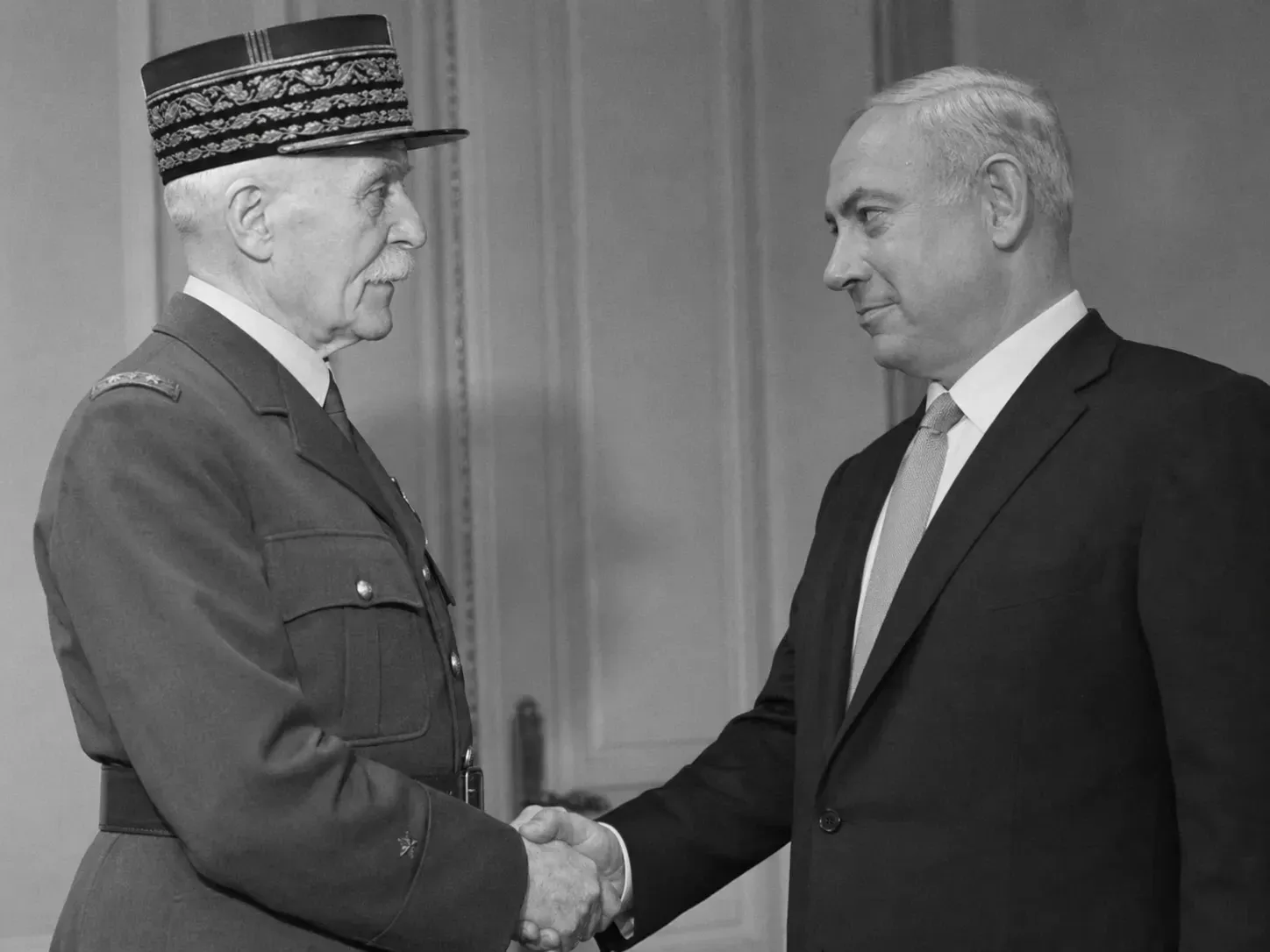
Today, Lebanon faces its own Vichy moment.
As Israeli forces consolidate control over parts of southern Lebanon, establishing security buffers, leveling entire villages—including my own, Hanin, now reduced to rubble where even the graves have been erased—and launching military incursions deep into Lebanese territory, the Lebanese government finds itself under extraordinary pressure. This pressure emanates not only from the occupying power but also from the United States, the European Union, and even several Arab states, all urging the state to dismantle and outlaw Hezbollah, the only organized force actively resisting that occupation. The government has indeed taken a decision outlawing the resistance (not the political party Hezbollah, that remains in parliament and in the government itself, but its resistance armed wing). This raises an important question: does a government that criminalizes its own citizens’ right to resist foreign occupation retain any legitimate claim to represent those citizens?
The Right That Cannot Be Surrendered
There is a dangerous misconception that the right to resist occupation is a political privilege granted by a parliamentary majority, or a concession that can be revoked by a simple vote of the legislature. This is a fundamental error in understanding the nature of sovereignty and human rights. The right to resist foreign domination is not a collective bargaining chip to be traded in the corridors of power; it is an inherent, individual right belonging to every single citizen, regardless of their sect, party affiliation, or political leaning. It is a right that exists prior to the state, preceding the constitution, and it cannot be surrendered by a majority, let alone a minority. Even if every citizen in Lebanon were to vote tomorrow to disarm and submit to occupation, that vote would be legally null and void, for no people can sign away their fundamental right to self-defense and self-determination.
After 1945, the people designing the new legal order were not just trying to punish crimes already committed. They were trying, perhaps a little desperately, to prevent their repetition in another form. The fear was no longer only of the foreign occupier. It was also of the local state that bends, adapts, and collaborates.
So the postwar legal architecture began to take shape around a dangerous question: what happens when the state ceases to be a shield and becomes the first instrument of submission? That is part of why later international law, especially under the pressure of anti-colonial movements, moved toward protecting resistance rather than simply criminalizing it.
In 1973, the newly decolonized nations of the world stood up at the United Nations and rewrote the rules that Vichy had exploited. Resolution 3103 declared that the struggle against “colonial and alien domination” is “legitimate and in full accordance with the principles of international law.” It was a direct rebuke to the logic of collaboration: it stated that those who fight an occupier are not criminals to be prosecuted, but combatants entitled to the protections of the Geneva Conventions.
Four years later, the world made this binding. Additional Protocol I (1977) shattered the colonial assumption that only states could wage lawful war. Article 1(4) redefined armed conflict to include wars against “alien occupation,” and Article 96(3) gave national liberation movements the mechanism to claim the full protections of international law. These provisions were written specifically for movements like the PLO, the ANC, the FLN—and yes, for the resistance movements of Lebanon at that time. The phrase “by all available means” in Resolution 37/43 (1982) was not an accident. It was inserted over the furious objections of the former colonial powers, who understood exactly what it meant.
The International Covenant on Civil and Political Rights and the International Covenant on Economic, Social and Cultural Rights — both ratified by Lebanon — affirm in their common Article 1 that “all peoples have the right of self-determination” and that “by virtue of that right they freely determine their political status and freely pursue their economic, social and cultural development.” The right to self-determination is not a privilege granted by states; it is a jus cogens norm — a peremptory norm of international law from which no derogation is permitted.
When Hezbollah fighters take up arms against Israeli forces on Lebanese soil, they are, in the most literal and legally grounded sense, Lebanese citizens exercising a right that international law recognizes as fundamental, inalienable, and non-derogable. Their identity as Shia Muslims, their ideological affinity with Iran’s Islamic Republic, their political ambitions within Lebanon — none of these biographical details negate the legal and moral reality: they are an occupied people resisting an occupying power, and international law stands with them, not with the government that would silence them.
The Anatomy of Collaboration
The Vichy regime did not begin with executions and mass deportations. Pétain and his ministers insisted that the armistice with Germany was necessary to preserve the French state, that collaboration was the only rational path, and that the Resistance was a dangerous fringe element provoking German reprisals against innocent civilians. The Vichy press called the Maquis “terrorists.” The Vichy courts sentenced them to death. The Vichy police handed them over to the Gestapo.
The logic was seductive in its pragmatism: we cannot defeat Germany, so resistance only brings more suffering. Order must be maintained. The state must survive.
But the state that survives by suppressing its own people’s right to self-defense has not survived at all. It has been hollowed out. It exists in name only, as an administrative convenience for the occupying power. This is the essential insight of the post-war French republic, which declared Vichy’s acts null and void from the beginning — not merely from the moment of liberation, but retroactively, from the very origin. The legal fiction of Vichy’s legitimacy was exposed as precisely that: a fiction.
Now consider the Lebanese government. It presides over a country where foreign troops control territory in the south. It commands an army that does not — and arguably cannot — challenge that occupation. And it is now being asked, under the combined weight of Israeli military pressure, American diplomatic leverage, and European financial incentives, to declare illegal the only force that is actually fighting to expel that occupation.
If it complies, what remains of its legitimacy?
The Colonial Genealogy of the Word “Terrorist”
The weaponization of the word “terrorist” to delegitimize resistance is neither new nor accidental. It is, in fact, one of the oldest and most effective instruments of colonial power — a linguistic technology developed by empire to transform the colonized subject’s refusal to submit into a pathology rather than a political act.
The British called the Mau Mau insurgents in Kenya “terrorists” as they herded hundreds of thousands of Kikuyu into concentration camps, torturing and castrating them in the name of civilization. The French called the FLN “terrorists” as they razed Algerian villages and drowned prisoners in the Seine. The apartheid regime in South Africa called the ANC “terrorists” as it enforced racial subjugation through pass laws, forced removals, and state-sponsored murder. The United States called the Vietnamese National Liberation Front “terrorists” as it dropped more tonnage of bombs on Southeast Asia than all combatants combined in the Second World War. The Israelis called the PLO “terrorists” as they occupied the West Bank, Gaza, and southern Lebanon — the very territory at issue today.
And in every single case, history reversed the verdict. The Mau Mau are recognized as freedom fighters. The FLN founded a nation. The ANC produced a president who received the Nobel Peace Prize. The Vietnamese liberated their country. The PLO took its seat at the United Nations. The “terrorist” label, it turns out, is not a permanent mark — it is a temporary convenience, applied by the powerful to the inconvenient, and discarded when the balance of power shifts.
The pattern is consistent and instructive: the designation “terrorist” is a political act, not a legal classification. It is the language the colonizer uses to refuse the colonized the dignity of a political opponent. To call a resistance fighter a “terrorist” is to say: you are not a combatant with rights; you are a criminal with none. You are not defending your homeland; you are attacking civilization itself. This is not law. It is propaganda, and it has always been propaganda, from Algiers to Soweto, from Hue to Tyre.
When the United States, the European Union, and Israel designate Hezbollah as a terrorist organization, they are making a geopolitical statement, not a legal determination. Under international humanitarian law, combatants engaged in hostilities against an occupying military force are not terrorists — they are combatants, entitled to the protections of the laws of war. Additional Protocol I says so. UNGA Resolution 3103 says so. The entire edifice of post-colonial international law says so. The deliberate conflation of resistance with terrorism serves a specific purpose: it removes the legal and moral shield that international law provides to occupied peoples, clearing the way for their suppression by any means necessary — including, conveniently, by their own government.
The Lebanese government, if it adopts this designation and codifies it into domestic law, is not merely following international consensus. It is importing a colonial weapon forged in Western capitals and turning it against its own citizens — citizens who are, by any honest reading of international law, exercising a recognized and protected right. It is performing the ultimate act of internalized colonialism: using the master’s vocabulary to condemn the slave who dares to rise.
The Monopoly That Was Never Earned
The standard objection runs as follows: the state must hold a monopoly on the legitimate use of force. Hezbollah’s independent military capacity is a violation of Lebanese sovereignty. Disarming it is not collaboration — it is the restoration of the state.
This argument has elegance but no foundation. It rests on a reading of sovereignty that is profoundly ahistorical — a reading that treats the state as an end in itself, rather than an instrument of the people’s will. The monopoly on force is not a divine right. It is a conditional grant from the people to the state, predicated on the state’s ability and willingness to protect them. When the state fails to defend the nation’s territory — when it cannot prevent foreign soldiers from establishing buffer zones on its soil, when it cannot stop airstrikes on its cities, when it cannot secure its own borders — the monopoly reverts to the people. The social contract is not a suicide pact. The people did not surrender their right to self-defense when they consented to be governed; they entrusted it to the state on the condition that the state would use it to protect them. That condition has been broken.
The Lebanese state has not earned the monopoly it claims. It has not defended southern Lebanon. It has not repelled the incursion. It has not protected the displaced. In the absence of state protection, citizens organized themselves. They found resources, built capacities, and took up arms. To now turn around and declare those citizens outlaws — not because they harmed their fellow Lebanese, but because they resisted a foreign army — is to invert the very logic of sovereignty.
It is to say: the state’s right to a monopoly on violence is more sacred than the people’s right to live free from occupation.
This is Vichy’s logic, stripped to its bones. And it is, at its core, a colonial logic — the logic that says the native must always defer to the institution, even when the institution has abandoned him; that the law exists to discipline the governed, never to empower them; that the supreme value is not freedom but order, not justice but obedience.
The Irrelevance of Allegiance
The most persistent objection to this argument is the Iranian one. Hezbollah, we are told, is not a genuine resistance — it is an Iranian proxy, fighting Israel not for Lebanon’s sake but for Tehran’s. Therefore, disarming it is not suppressing resistance; it is liberating Lebanon from two foreign powers at once.
This argument collapses under the slightest scrutiny.
First, it conflates motivation with action. A Lebanese citizen who takes up arms to drive Israeli forces out of his village is performing an act of resistance regardless of what inspired him to do so. The legal right to resist does not come with an ideological purity test. The French Resistance included communists who took orders from Moscow. No serious historian argues that this invalidated their right to fight the Gestapo. The Afghan mujahideen who fought the Soviet occupation were celebrated as freedom fighters in Washington, even as they received funding, training, and direction from the CIA and Pakistani intelligence. Their foreign backing did not negate their right to resist — it was, in fact, the mechanism through which that right was exercised. The Viet Cong received the entirety of their military capacity from the Soviet Union and China. Nobody — not even the Americans who bombed them — argued that this transformed a war of national liberation into something illegitimate. The right to resist attaches to the fact of occupation, not to the biography of the resister.
Second, it assumes a symmetry that does not exist. Iran’s influence over Hezbollah is real and consequential. But Iran is not occupying Lebanese territory. Iran is not bombing Lebanese villages. Iran is not establishing military buffer zones on Lebanese soil. Whatever Hezbollah’s relationship with Tehran, the bullets flying into southern Lebanon are Israeli, not Iranian. The boots on the ground are Israeli. The walls being built are Israeli. The right to resist responds to facts on the ground, not to the geopolitical sympathies of the resisters. To equate Iranian political influence with Israeli military occupation is a moral obscenity — it places a diplomat’s whisper on the same scale as a soldier’s boot, and declares them equivalent violations of sovereignty. They are not.
The International Enablers
No government makes the decision to outlaw its own resistance in a vacuum. The pressure on Lebanon is not subtle. It comes wrapped in the language of aid, reconstruction, and international legitimacy. The message from Washington and Brussels is clear: disarm Hezbollah, and the funds will flow. Refuse, and you will remain a pariah state, broke and broken.
This is not diplomacy. It is extortion. And it reveals something deeply structural about the international order — something that the formerly colonized world has understood since Bandung.
The same Western governments that invoke international law to demand Hezbollah’s disarmament are conspicuously silent on the occupation that necessitates Hezbollah’s existence. The same United Nations that affirms the right of peoples to resist foreign domination passes resolutions demanding the disarmament of those who exercise that right. The same European Union that designates Hezbollah a terrorist organization recognizes, in its own founding documents, the right of self-determination and the illegitimacy of territorial acquisition by force. The same United States that arms Israel to the teeth lectures Lebanon on the dangers of armed non-state actors.
The international community, in this reading, is not a neutral arbiter. It is an enabler of the Vichy dynamic — providing the diplomatic cover, the financial incentives, and the legal frameworks that allow a government to suppress its own people’s resistance without appearing to betray them.
The Cost of Compliance
Let us consider, for a moment, what actually happens if the Lebanese government complies. Let us trace the logic of disarmament to its conclusion — not as the diplomats imagine it in their conference rooms, but as it will unfold in the villages and valleys of the south.
Hezbollah is outlawed. Its political wing is banned. Its social services — the hospitals, the schools, the infrastructure networks that sustain hundreds of thousands of Lebanese citizens whom the state has abandoned — are dismantled or seized. Its fighters are ordered to surrender their weapons or face arrest.
Do they comply? Some might. Most will not. The fighters of the south did not take up arms because a political party told them to. They took up arms because their homes were being bombed and their fields were being occupied. They took up arms because the state was absent and the bombs were present. Outlawing the organization does not extinguish the grievance. It drives it underground — and underground, grievances do not disappear. They metastasize.
The result is predictable: a new insurgency, fragmented, leaderless, and far more dangerous than the organized resistance it replaces. The state, having criminalized the only structured force capable of maintaining order in the south, inherits a security vacuum it cannot fill. The Israeli occupation, freed from the constraint of organized resistance, expands. The displaced remain displaced. The dead remain dead. And the cycle of violence intensifies, now with the added fuel of internal betrayal.
This is the lesson that every colonial power learned the hard way: you cannot legislate away a people’s will to be free. The British could not do it in Kenya. The French could not do it in Algeria. The Americans could not do it in Vietnam. The Israelis could not do it in Gaza. And the Lebanese government will not do it in the south — not because Hezbollah is uniquely resilient, but because the impulse to resist occupation is universal, irrepressible, and older than any state.
And the government in Beirut, having traded its people’s right to resist for a seat at the international table, discovers that the table was set for someone else’s feast.
What Legitimacy Means
Legitimacy is not a certificate issued by the United Nations. It is not a seat at the General Assembly or a flag outside a diplomatic building. Legitimacy is the bond between a government and its people — the bond that says: we will protect you, and in return, you will obey our laws.
When a government breaks that bond — when it fails to protect, and then criminalizes those who protect themselves — it does not merely lose legitimacy. It becomes something worse than illegitimate. It becomes complicit. It becomes the instrument through which the occupation is made cheaper, easier, and more durable. For what is an occupying power’s greatest asset if not a local government willing to police the resistance on its behalf?
This was Vichy’s function. Not to fight France’s battles, but to suppress the French who would. Not to expel the Germans, but to ensure that no one else did either. The Vichy state was, in the final analysis, a labor-saving device for the Wehrmacht — and the Wehrmacht, for its part, was grateful for the efficiency.
If the Lebanese government outlaws Hezbollah while Israeli forces remain on Lebanese soil, it will have assumed the same function. Not by ideology — Lebanon is not a fascist state. Not by preference — no Lebanese official desires occupation. But by effect, which is what history judges. The road to collaboration is not always paved with conviction. Sometimes it is paved with exhaustion, with fear, with the slow erosion of principle under the weight of external pressure. But the destination is the same.
The Verdict of the Future
In 1944, when Allied forces and the French Resistance liberated Paris, the first act of the provisional government was to declare the Vichy regime null and void — not from the date of liberation, but from its inception. The message was clear: a government that suppresses its people’s right to resist occupation was never legitimate. It was a legal fiction from the first day.
History will render the same verdict on any government that outlaws resistance while its territory remains occupied. The names and flags and constitutional citations will differ. The principle will not.
And history’s verdict will be harsher still for those who enabled it — the diplomats who applied the pressure, the institutions that provided the cover, the governments that funded the capitulation while arming the occupation.
A state that cannot protect its people has no right to forbid them from protecting themselves. This is not a radical proposition. It is the minimum condition of legitimacy. It is the principle on which every liberation movement in modern history has stood — from Algiers to Hanoi, from Soweto to Bint Jbeil. Everything else — the diplomatic recognitions, the UN seats, the constitutional procedures — is decoration on a structure whose foundation has already collapsed.
The Lebanese government now stands at a precipice. It can stand with its people, honoring the inalienable right to defend their soil, or it can place itself between the people and that very right. It cannot do both. History, which has already rendered its verdict on Vichy, will not hesitate to judge this moment with the same unforgiving clarity.